The Idea in One Picture
Light That Gets Farther Away Before It Arrives
Every picture on this page is calculated by the simulator from the Friedmann equation, using the contents of the universe measured by the Planck satellite. The numbers agree with an independent calculation to better than one part in a billion. Nothing is drawn by hand.
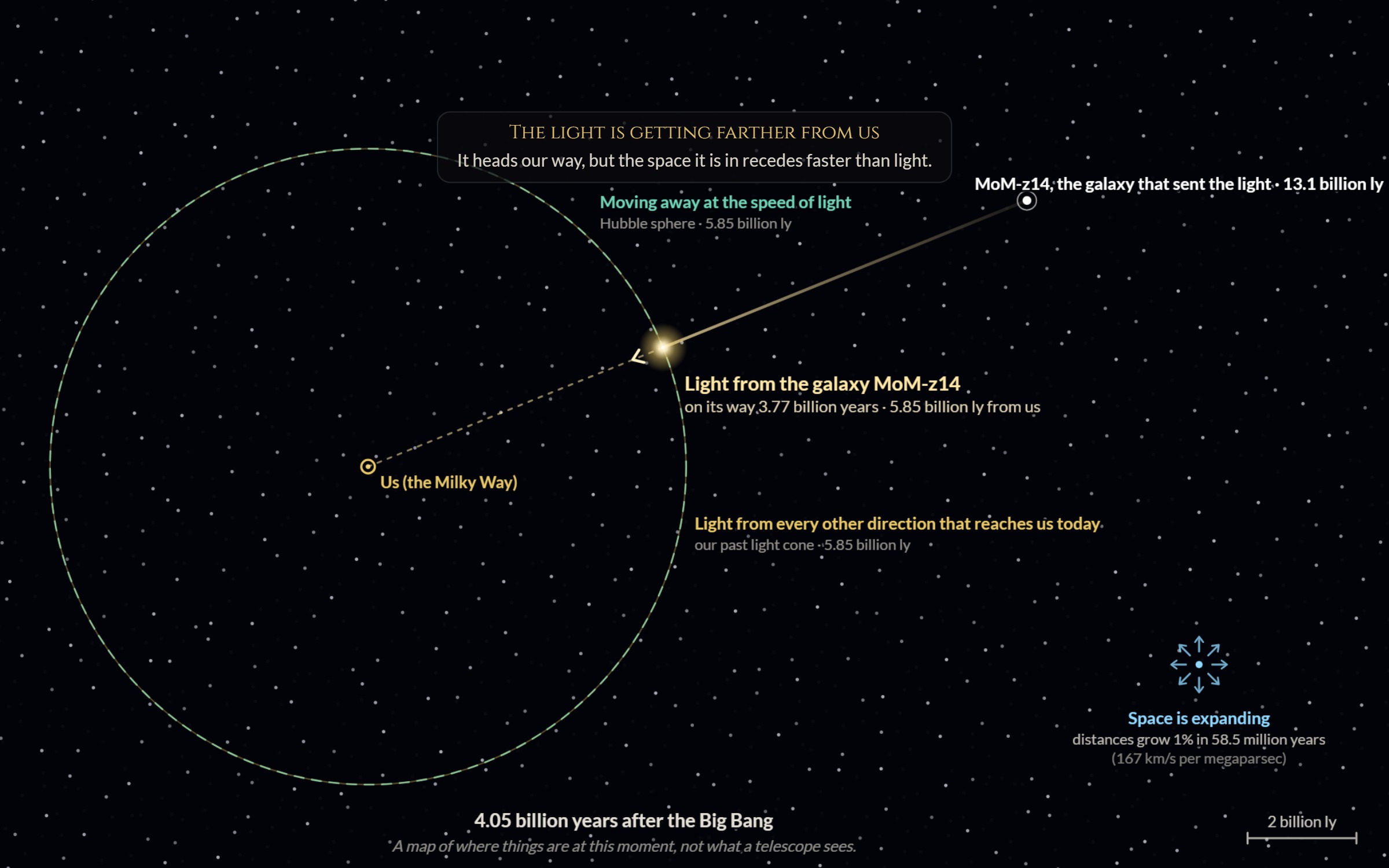
Distances grow
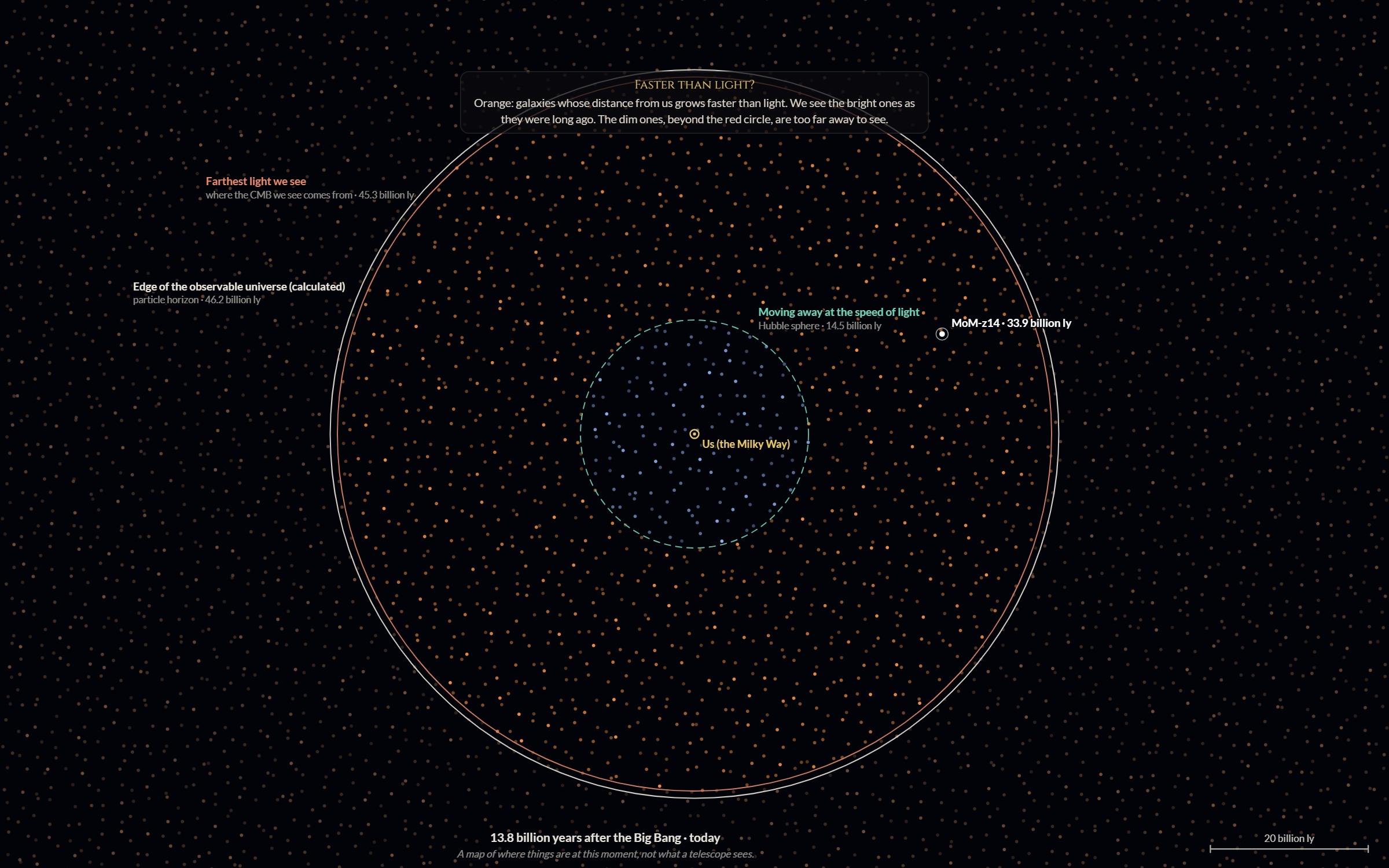
The distances between galaxies that are not held together by gravity all grow in proportion. Today a distance grows by about one part in 14.5 billion each year; that rate is the Hubble constant, 67.7 kilometres per second per megaparsec. The farther away a galaxy is, the faster its distance from us grows, and beyond 14.5 billion light-years it grows faster than light travels.
Light can be carried away at first
Light crosses the space around it toward us at the speed of light, c, but the space it is in recedes from us at H × D, where D is its distance from us and H the expansion rate at that time. So its distance changes at H × D − c. MoM-z14's light set out 2.19 billion light-years away, where space receded at 5.2 times the speed of light (the Hubble sphere, where H × D = c, was then only 0.43 billion light-years away). So although it headed toward us, the light was carried outward for 3.8 billion years, to 5.85 billion light-years. Meanwhile H fell and the Hubble sphere grew. When the Hubble sphere reached the light, the light stopped receding, and from then on it came closer.
What we see, and what we can reach
The oldest light we see, the cosmic microwave background, left gas that is now about 45 billion light-years away, although the universe is only 13.8 billion years old. And light we send out today will never reach galaxies we now see with a redshift above 1.85, which are more than 16.6 billion light-years away. Of the observable universe out to the first galaxies, that is about 90% by volume.
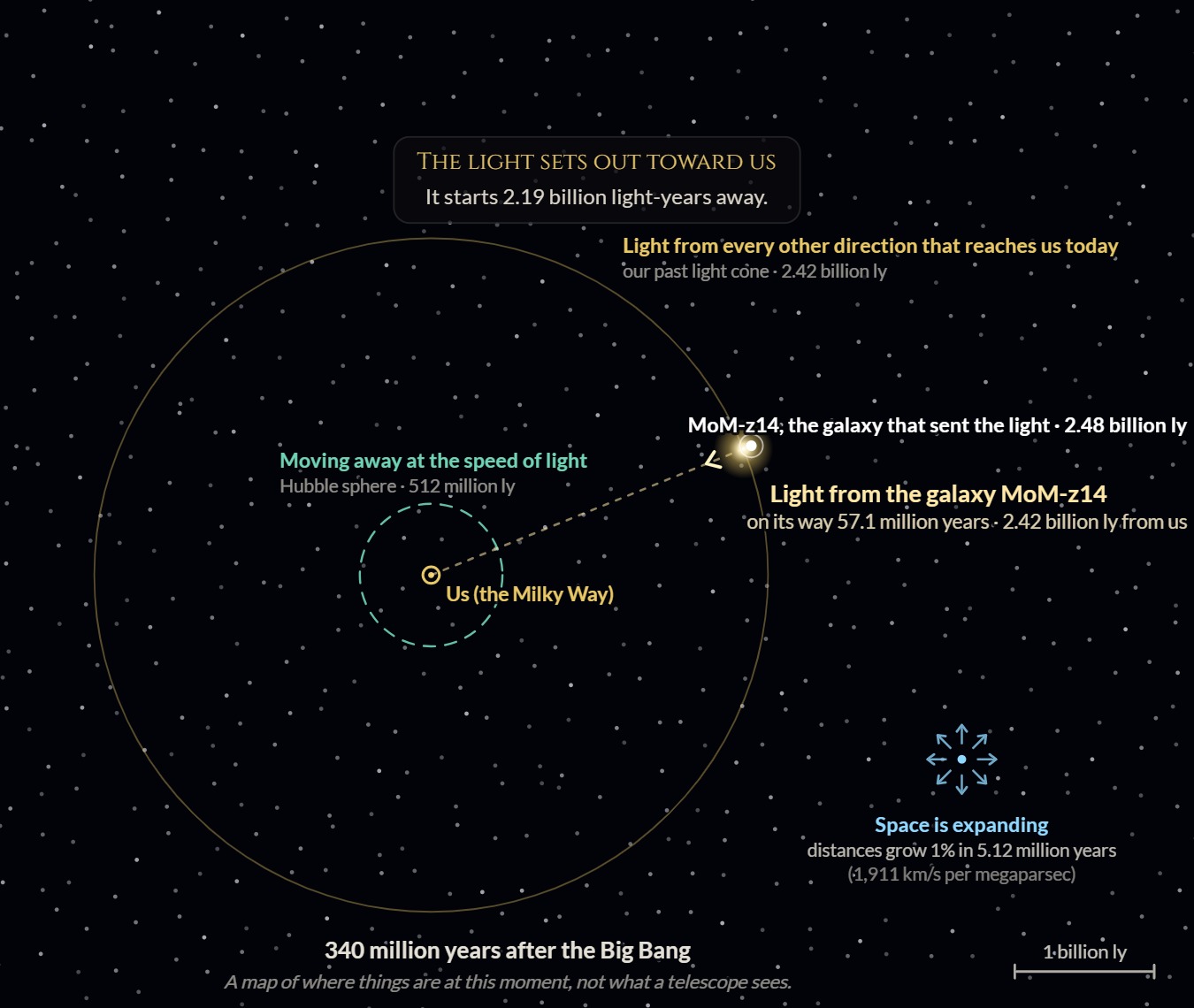 340 million years after the Big Bang: the light set out 57 million years ago, 2.19 billion light-years from us, and is already 2.42 billion light-years away.
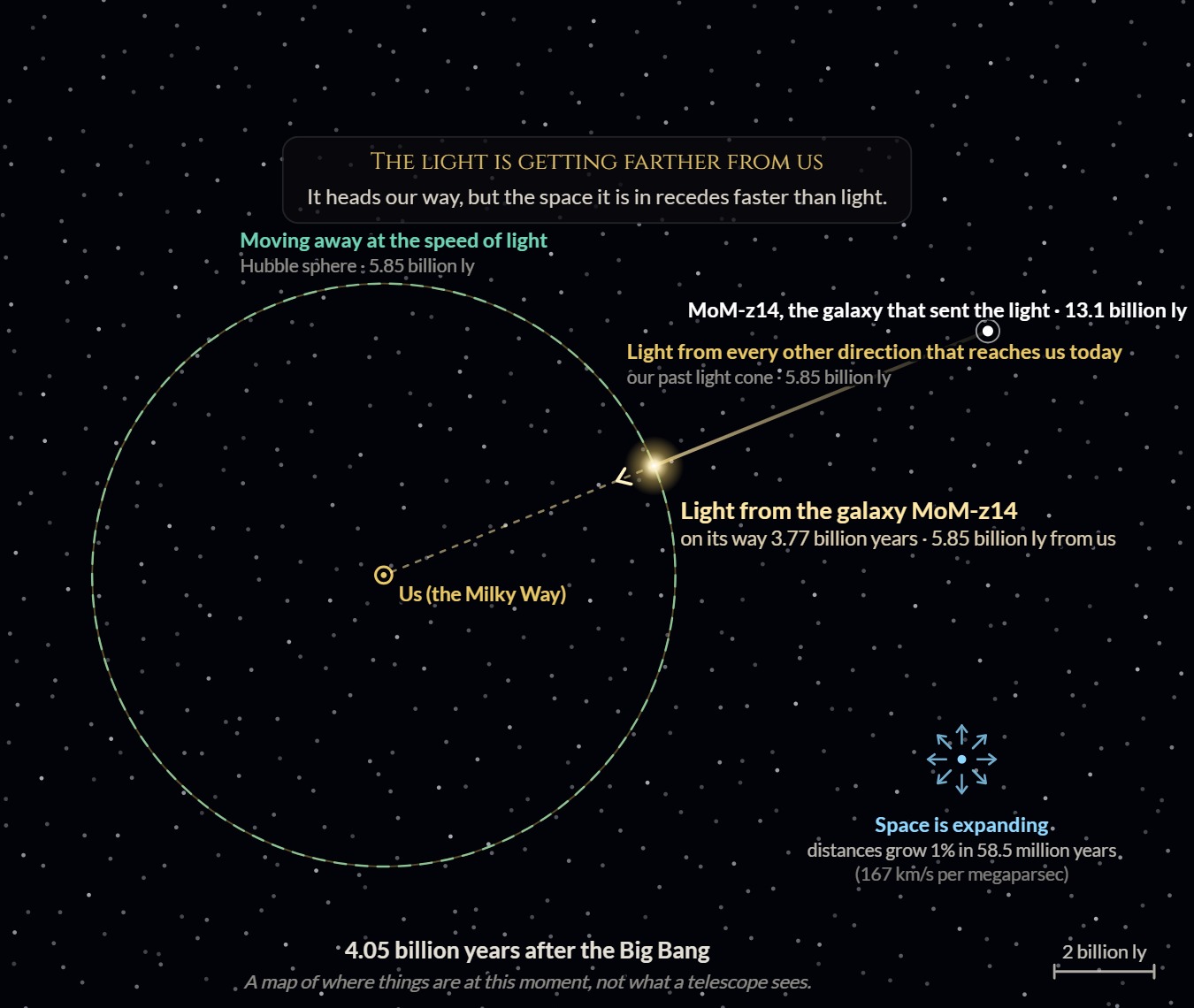 4.05 billion years: 5.85 billion light-years from us, its farthest.
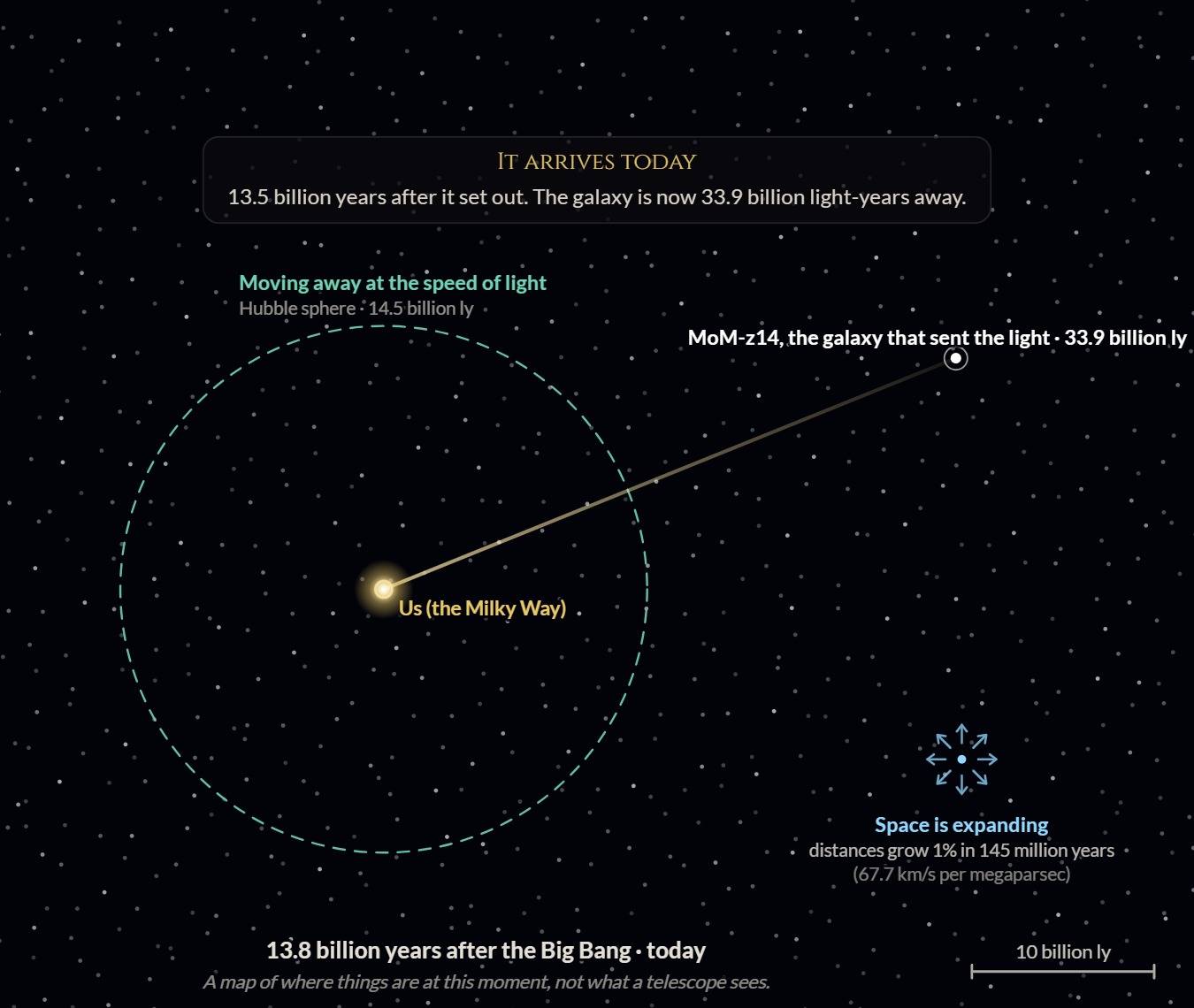 Today: the light arrives. MoM-z14 is now 33.9 billion light-years away.
In Everyday Terms
Billions of Years, Billions of Light-Years
The arithmetic for each number is in the notes under References.
About This Page
A Simulation, Not an Animation
Try this first. The universe is 13.8 billion years old, and nothing travels faster than light. So how far away is the most distant thing we can see?
Not 13.8 billion light-years. The oldest light we see left gas that is now about 45 billion light-years away.
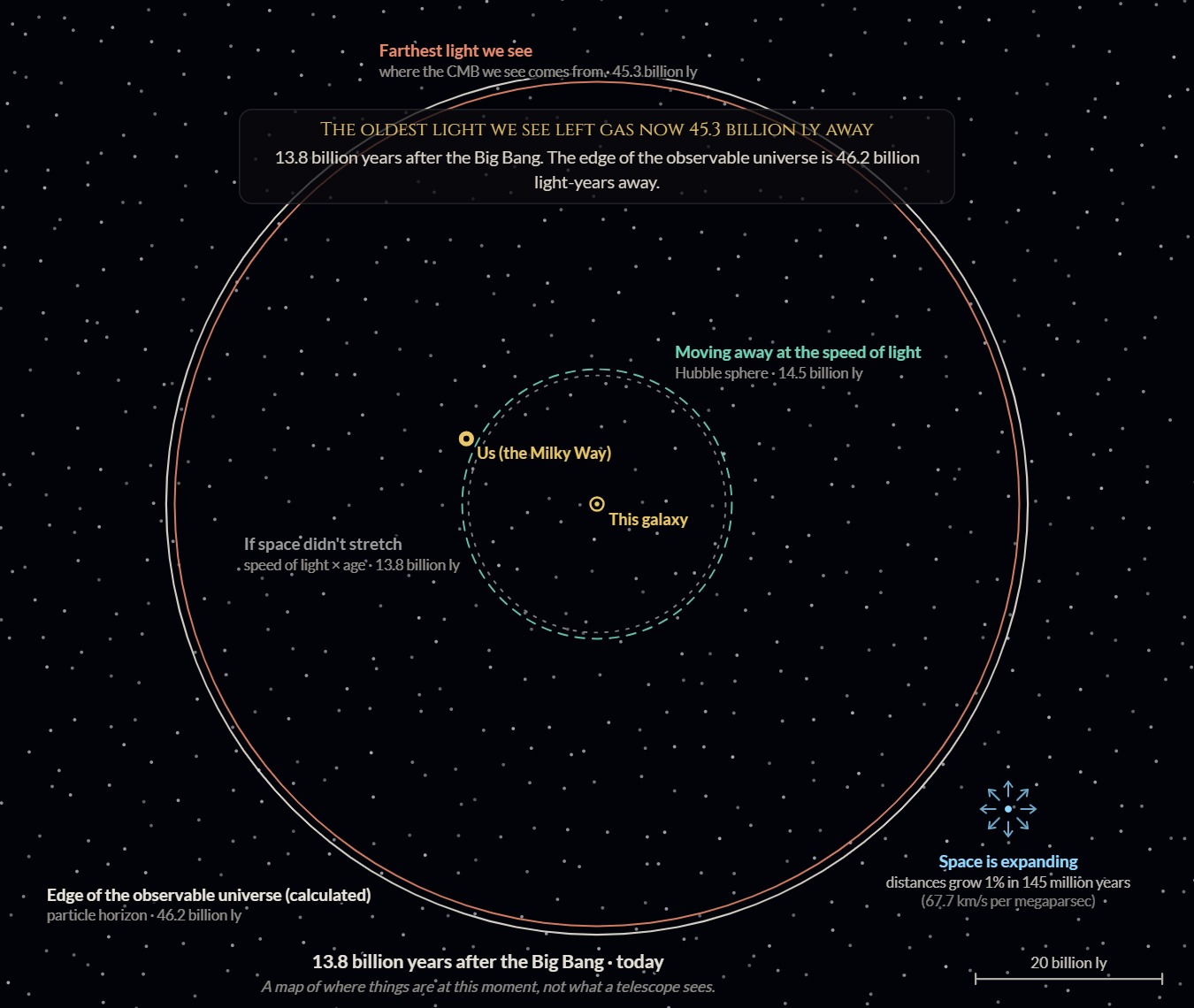
The simulator shows a map of the universe at one moment of cosmic time, with us at the centre. It is a map, not a view through a telescope: it shows where things are at that moment, while a telescope shows each thing as it was when its light left. The dots stand in for galaxies, and they move apart as the universe expands. The circles mark the Hubble sphere (where things recede at the speed of light), the light now on its way to us, the farthest light we see, the edge of the observable universe and, in some views, the event horizon. You can follow the light of real galaxies from the moment it left, change what the universe is made of, centre the map on another galaxy, open a spacetime diagram of the same calculation, and run the clock a trillion years into the future. Hold the pointer over any view, setting or number for a short explanation.
Calculated, not drawn. Every circle, position and number comes from the Friedmann equation, which gives the expansion rate from what the universe contains: radiation, matter (ordinary and dark) and dark energy, in the amounts measured by the Planck satellite. The expansion then sets how far light can travel, when it arrives, and how much distances grow on the way. The page's calculation agrees with an independent one to better than one part in a billion (see Verification below). It runs on any computer or phone. Built with Claude Opus 5.5, which did the physics design, the drawing code, the test programs and this write-up.
What You're Seeing
Reading the Map
The map
A slice through the universe at one moment of cosmic time, the time since the Big Bang shown at the bottom. Distances are to scale; the scale bar is in the corner. No one can see the universe like this: looking out is looking back in time, so a telescope sees each galaxy where it was when its light left. In the "Out of reach" view the map is drawn at today's scale instead, so that the galaxies stay in place while time runs on.
The dots
A pattern of places that move apart with the expansion, standing in for galaxies. They are not real galaxies, and they are faint before about 200 million years, when the first galaxies formed. “Centre on another galaxy”, in the settings, redraws the map around one of them: the circles around it are exactly the same, because every galaxy sees the same picture. There is no centre.
The light (gold)
In the first view, the bright dot is the light of the chosen object on its way to us. The solid line behind it runs back to the object that sent it, and the dashed line ahead of it to us. The faint gold circle is our past light cone: where all the light that reaches us today, from every direction, was at the moment shown. It first grows, then shrinks onto us.
Space is expanding
The small marker with arrows gives the expansion rate at the moment shown, as the time in which distances grow by 1%, and as the Hubble rate in kilometres per second per megaparsec. Today it is 145 million years and 67.7; when MoM-z14's light set out it was 4.3 million years and about 2,300.
Moving away at the speed of light (dashed teal)
The distance at which things recede at the speed of light, called the Hubble sphere. It is 14.5 billion light-years today. It is not an edge: light from beyond it reaches us, and we see many galaxies beyond it.
Farthest light we see (red)
The gas whose glow we see as the cosmic microwave background, released 372,000 years after the Big Bang when the universe became transparent. Before that, light could not travel freely, so this is the oldest light we can see.
Edge of the observable universe (white)
The farthest distance from which anything, light or otherwise, could have reached us since the Big Bang, called the particle horizon: 46.2 billion light-years. It is a calculation, not something we see: the last 0.9 billion light-years of it lie beyond the cosmic microwave background, in the opaque early universe.
If space didn't stretch (grey)
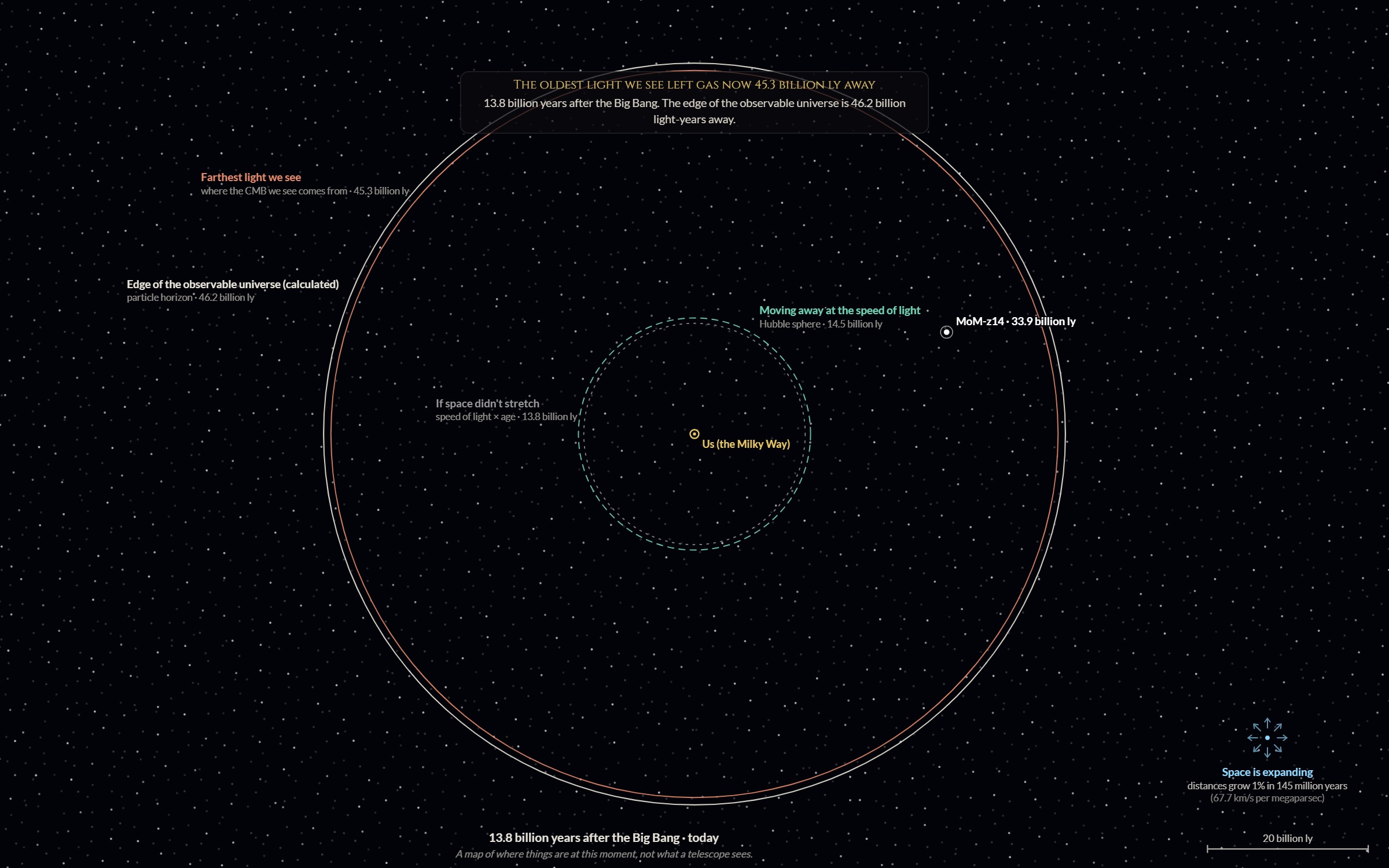
How far light would have travelled since the Big Bang if distances didn't grow: the speed of light times the age, 13.8 billion light-years today. Today this is close to the Hubble sphere (14.5), a coincidence of our era that doesn't hold at other times.
Event horizon (violet)
Light sent from beyond this distance at the moment shown will never reach us, and light we send at that moment will never reach there. It is 16.6 billion light-years today. It exists because the expansion is speeding up; in a universe without dark energy there is none.
The card
For the chosen object: when its light left, three answers to "how far away is it" (how long the light travelled, the distance when it left, the distance now), how fast its distance from us grew then and grows now, how large a galaxy like ours would look there, and whether a signal we send today could ever reach it.
The spacetime diagram
The same calculation with time running upward and distance across. The map is one horizontal slice of it. With distance at that moment, the light reaching us today makes a teardrop; with today's distances and conformal time (a time scaled so that light always moves at 45°), it becomes a triangle. It follows Figure 1 of Davis and Lineweaver (2004).
At a Glance
Our Universe in Numbers
What the Calculation Shows
Faster Than Light, and Still in View
Many common statements about the expanding universe are wrong, or right only with conditions attached. Davis and Lineweaver (2004) collected misleading passages on exactly these points from textbooks, popular books and research papers. Here is what the calculation says.
Distances to galaxies grow faster than light. The farther away a galaxy is, the faster its distance from us grows. Beyond the Hubble sphere, 14.5 billion light-years away today, the distance grows faster than light travels. That includes every galaxy we see with a redshift above 1.48. That doesn't break relativity. Relativity says that nothing can move through space faster than light, so nothing can overtake a beam of light. No galaxy does that: each one moves only slowly through the space around it, and anyone in any galaxy who measures a passing beam of light finds it moving at exactly the speed of light. What grows faster than light is the amount of space between us and a distant galaxy, and relativity sets no limit on how fast that can grow. A "recession speed" between galaxies far apart depends on how distance and time are defined. Here, as in most of cosmology, distance is measured at one moment of cosmic time, and the recession speed is how fast that distance grows.
We see them anyway. All the galaxies above redshift 1.48 are receding faster than light today, and those above redshift 1.59 already were when they sent the light we now see. MoM-z14's distance was growing at 5.1 times the speed of light when its light set out; it now grows at 2.3 times.
Light from them first gets farther away. The distance D between us and a ray of light heading our way changes at H × D − c: the light crosses the space around it toward us at the speed of light, while that space recedes from us at H × D. Beyond the Hubble sphere, H × D is larger than c, so the light is carried away from us even though it is heading our way. It starts to approach only once the Hubble sphere has grown past it. The Hubble sphere grows because the expansion rate falls: even today, while the expansion speeds up, H (how fast each distance grows, per unit of distance) keeps falling. In our universe, light from every galaxy above redshift 1.6 was carried away at first. Davis and Lineweaver point it out in their Figure 1.
All the light reaching us today travelled together. Light arriving now from a given direction followed one path, so at any past moment it was all at the same distance: on the gold circle. That circle was never larger than 5.85 billion light-years, which it reached 9.7 billion years ago, when the light on it was exactly at the Hubble sphere. So every galaxy we see, however distant, was less than 5.85 billion light-years from us when its light set out.
The Hubble sphere is not a horizon. Light crosses it inward, and we see far beyond it. It is also not where the event horizon is today (16.6 billion light-years). In the far future, as dark energy takes over, the two settle at the same distance, 17.4 billion light-years.
How Far Away Is It?
Three Honest Answers
In an expanding universe, "how far away" has more than one answer, and news stories usually give how long the light travelled. NASA wrote of the lensed star Earendel that "its light has taken 12.9 billion years to reach Earth", and called that "nearly 13 billion light-years" (for the redshift then estimated, 6.2; the measured redshift of its host galaxy is now 5.93, which gives 12.8); ESA said in July 2026 that the two most distant quasars known "lie just over 13 billion light-years away". Those are light-travel times. The same quasar, EUCL J1729+6410, is now 29.6 billion light-years away, and was 3.4 billion light-years away when its light left.
| Object | Redshift | Light travelled for | Distance then | Distance now | Receding then / now | A signal from us today arrives |
|---|---|---|---|---|---|---|
| Virgo Cluster | 0.0037* | 53.7 million years | 53.6 million ly | 53.8 million ly | 1,120 km/s | in 54 million years |
| Coma Cluster | 0.024 | 341 million years | 337 million ly | 345 million ly | 0.024 c | in 349 million years |
| 3C 273 (quasar) | 0.158 | 2.05 billion years | 1.90 billion ly | 2.20 billion ly | 0.14 c / 0.15 c | in 2.38 billion years |
| SN 1997ap (supernova) | 0.83 | 7.18 billion years | 5.26 billion ly | 9.63 billion ly | 0.59 c / 0.67 c | in 14.9 billion years |
| Earendel (lensed star) | 5.93 | 12.8 billion years | 3.95 billion ly | 27.4 billion ly | 2.8 c / 1.9 c | never |
| EUCL J1729+6410 (quasar) | 7.77 | 13.1 billion years | 3.37 billion ly | 29.6 billion ly | 3.4 c / 2.0 c | never |
| GN-z11 (galaxy) | 10.60 | 13.4 billion years | 2.74 billion ly | 31.8 billion ly | 4.2 c / 2.2 c | never |
| JADES-GS-z14-0 (galaxy) | 14.18 | 13.5 billion years | 2.22 billion ly | 33.7 billion ly | 5.1 c / 2.3 c | never |
| MoM-z14 (galaxy) | 14.44 | 13.5 billion years | 2.19 billion ly | 33.9 billion ly | 5.1 c / 2.3 c | never |
| Cosmic microwave background | 1,090 | 13.8 billion years | 41.5 million ly | 45.3 billion ly | 66 c / 3.1 c | never |
* The Virgo Cluster is placed at its measured distance, 16.5 megaparsecs (Mei et al. 2007); 0.0037 is the expansion's share of its redshift. Its observed redshift, 0.0044, also includes the cluster's own motion and ours. Nearby, such motions are a large part of a redshift: Andromeda, the nearest large galaxy, is approaching us at about 300 km/s (110 km/s relative to the Milky Way) and is held to us by gravity.
The most distant galaxies look larger. In a flat universe like ours, the size a galaxy appears on the sky depends on its distance when its light left, and that distance is largest, 5.85 billion light-years, for galaxies at redshift 1.59. A galaxy the size of the Milky Way would look smallest there, 3.5 arcseconds across, and larger at higher redshifts: 9.4 arcseconds at MoM-z14's redshift. Real early galaxies are much smaller than the Milky Way, so they still look tiny, and they are much dimmer, because the brightness of each patch of a galaxy falls as (1 + z)4 (Tolman 1930).
The Future
Out of Reach, but Still in View
The expansion has been speeding up for the last 6 billion years, which is what dark energy does. Because of it, there is a distance beyond which light sent today will never reach us, however long we wait: the cosmic event horizon, 16.6 billion light-years away today. It works both ways. A signal we send now will never reach galaxies beyond it, and whatever happens there today we will never see. Galaxies we see with a redshift above 1.85 are already beyond it. By volume, that is 95% of the observable universe, and about 90% of it out to redshift 20, about where the first galaxies were forming. These fractions are of the part of the universe we can see; the universe as a whole may be far larger, or infinite.
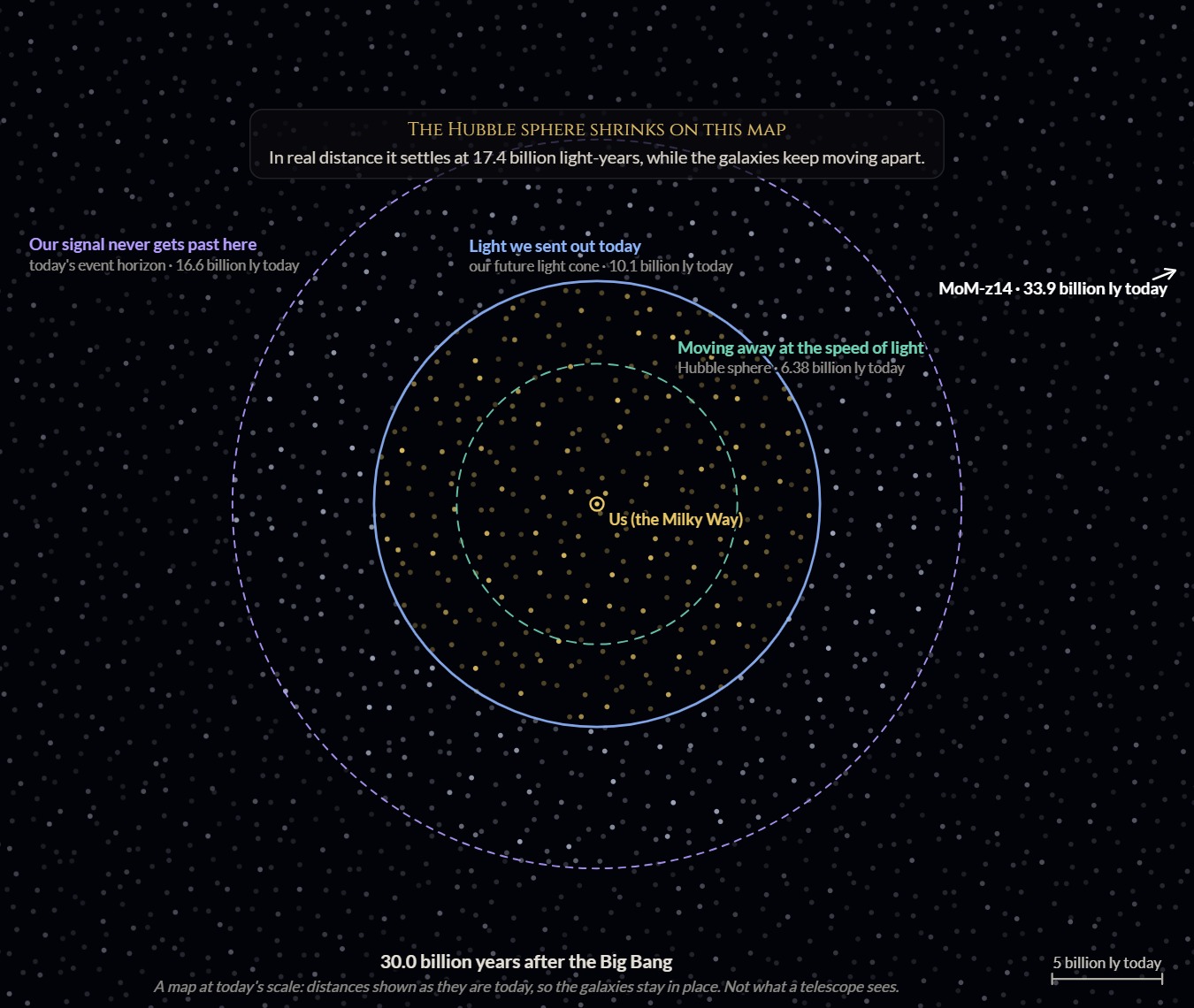 30 billion years after the Big Bang: our signal has reached the gold galaxies.
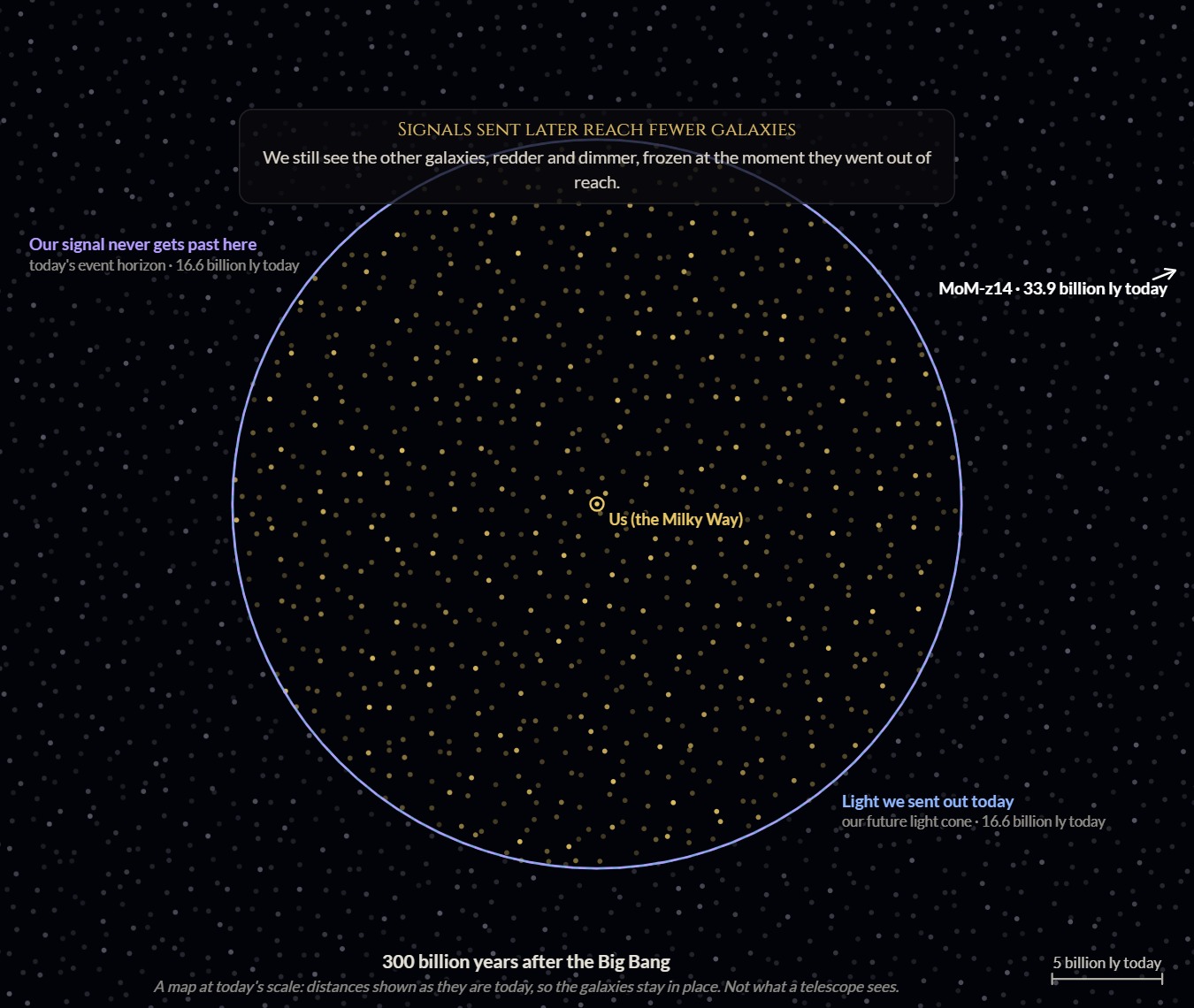 300 billion years: it has almost stopped. The grey galaxies will never receive it.
Galaxies don't vanish when they cross it. We keep receiving light they sent before they crossed, ever redder, dimmer and more slowed down, as if they were frozen at that moment. When the universe is 150 billion years old, the light of the Virgo Cluster will arrive with a redshift of 8.2, like the most distant galaxies seen today, and that of the Coma Cluster with 53, far beyond any galaxy seen today. Krauss and Scherrer (2007) pointed out that astronomers in the far future would find the expansion, the cosmic microwave background and the other evidence for the Big Bang ever harder to detect, and might conclude that they live in a static universe. Our own galaxy and its neighbours, held together by gravity, will have merged and will stay together.
We will never see much more than we do now. The edge of the observable universe grows forever, but in today's distances it stops at 62.8 billion light-years, so the volume we will ever see is only 2.5 times what we see now.
How It's Measured
From Redshifts to the Contents of the Universe
A redshift is measured from a spectrum: known lines of hydrogen, oxygen or other atoms appear at longer wavelengths, stretched by a factor 1 + z, the factor by which distances have grown since the light left. Vesto Slipher measured the first galaxy velocities between 1912 and 1917; most were redshifts, meaning the galaxies were moving away. Georges Lemaître showed in 1927 that an expanding universe predicts redshifts growing in proportion to distance, and estimated the rate from published measurements; Edwin Hubble found the relation in his own data in 1929. Hubble's rate, about 500 kilometres per second per megaparsec, was seven times too high, because his distances were far too small.
Distances come from objects of known brightness, such as pulsating stars and type Ia supernovae, and from objects of known size, such as the pattern that sound waves in the early universe left in how galaxies are spread out (baryon acoustic oscillations). In 1998 two teams found that distant supernovae are fainter than they would be if the expansion were slowing down: it is speeding up (Nobel Prize 2011). The cosmic microwave background, mapped by the Planck satellite, gives the contents of the universe with high precision, and they are the input to this page. Two measurements show that the universe really is expanding, rather than light losing energy on its way: distant supernovae brighten and fade more slowly, by the factor 1 + z within the measurement errors (Goldhaber et al. 2001; Blondin et al. 2008), and the surface brightness of galaxies falls with redshift as the expansion predicts, once the galaxies' own evolution is allowed for (Lubin and Sandage 2001).
Two measurements disagree. Distances from nearby supernovae give an expansion rate of about 73 km/s per megaparsec (Riess et al. 2022), while the cosmic microwave background gives about 67.7 (Planck). This "Hubble tension" is unresolved. And in 2025 the DESI survey, which maps the sound-wave pattern in more than 14 million galaxies and quasars, found a hint that dark energy is slowly weakening: 2.8 to 4.2 sigma depending on the supernovae combined with it, and about 3 sigma after a 2026 recalibration of one supernova sample (Popovic et al. 2026). If that holds, the event horizon and the far future shown here would change. This page uses a constant dark energy, as in Planck's standard model.
Controlled Experiments
Switch Off the Physics, One Effect at a Time
Each comparison changes one thing, so you can see what it contributes. Every image was rendered by the simulator, and you can recreate them with the settings named.
Space that doesn't stretch
The "How far can we see?" view, today. If distances didn't grow, the farthest we could see in 13.8 billion years would be 13.8 billion light-years (grey). The farthest light we see comes from 45.3 billion light-years away (red), and the edge of the observable universe is at 46.2 (white). The grey circle sits next to the Hubble sphere (dashed teal, 14.5) only by coincidence. For most of cosmic history the Hubble sphere was about one and a half times larger than this circle; the two cross 1.2 billion years from now, and then the Hubble sphere stops growing at 17.4 billion light-years while this circle keeps growing.
Dark energy
Universe: "No dark energy, flat", with the same expansion rate today and enough matter to keep space flat. The universe would be only 9.6 billion years old, younger than the oldest star clusters in our galaxy (about 13 billion years); before 1998 this "age problem" was a real puzzle. The edge of the observable universe would be 28.6 billion light-years away, the expansion would always slow down, and there would be no event horizon: every galaxy could eventually be reached. With the same matter as ours and no dark energy (the open universe in the list), the age is 11.6 billion years and there is still no event horizon.
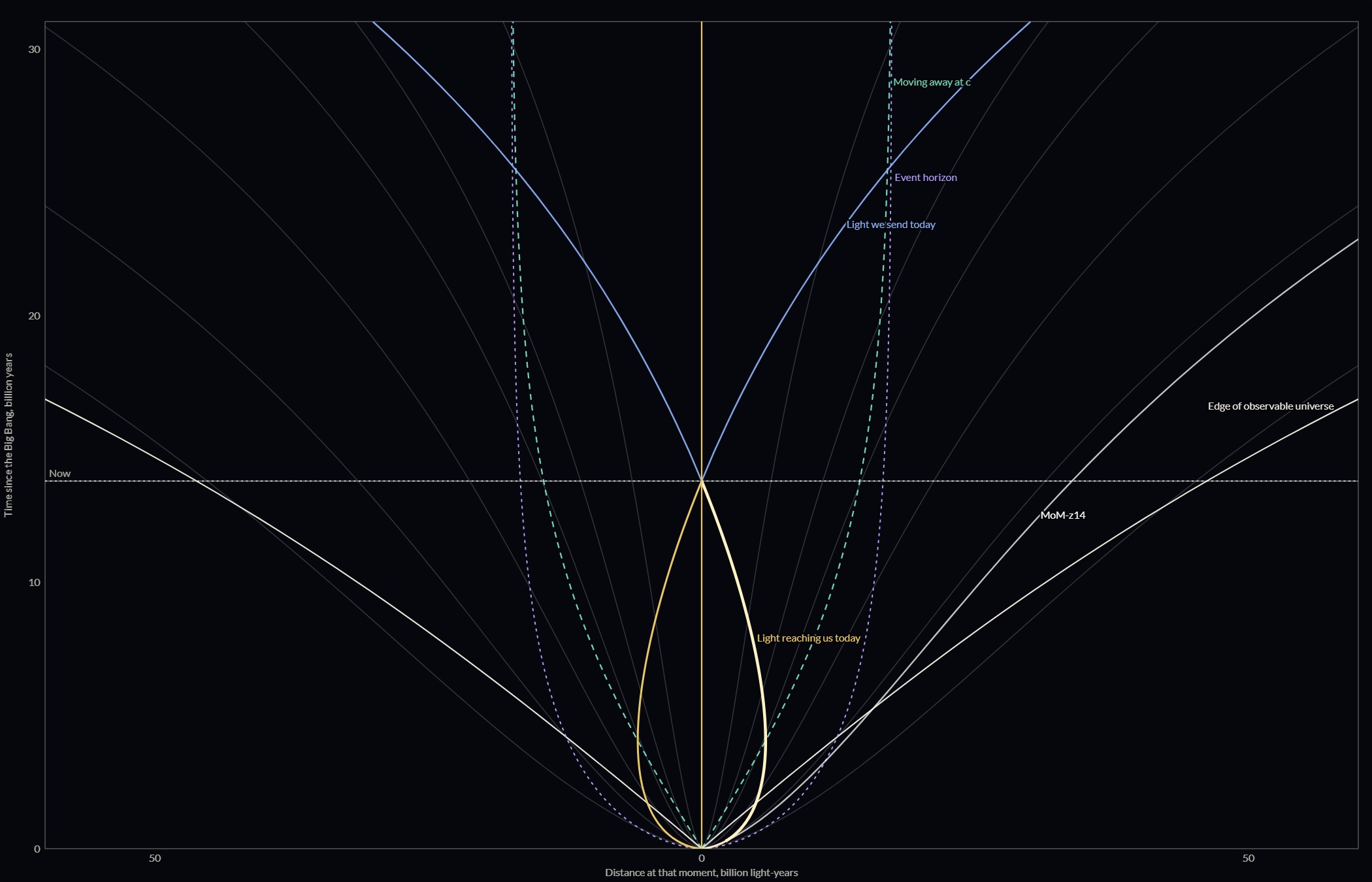 Our universe: the event horizon (dotted violet) exists
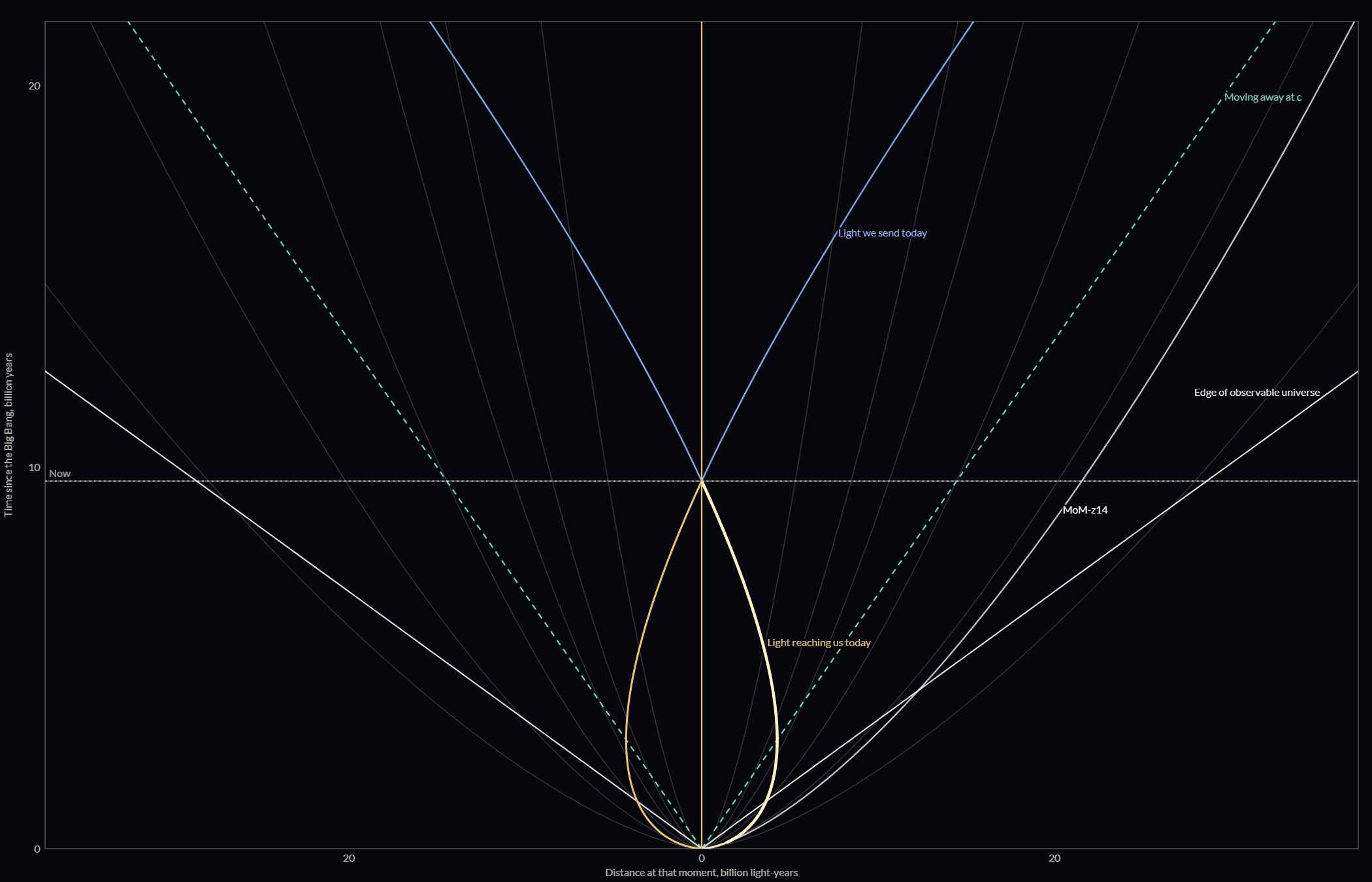 No dark energy: younger, and no event horizon
Radiation
Universe: Custom, "Radiation" off. The light and neutrinos left over from the hot early universe make up only 0.009% of its contents today, but they dominated the first 50,000 years or so. Without them the age changes by only 0.04%, but the edge of the observable universe moves out by 1.9%, from 46.2 to 47.1 billion light-years, because the early expansion would have been slower and light would have had longer to travel.
The expansion rate
Universe: Custom, "Expansion rate today" from 67.7 to 73 km/s per megaparsec, the value from nearby supernovae, with everything else the same. Every time and distance shrinks almost exactly in proportion: the age becomes 12.8 billion years, the edge 42.8 billion light-years and the event horizon 15.4. Only the expansion rate changed here; analyses that find a faster rate also find slightly different amounts of matter, so this is an illustration, not a model of the universe.
Two ways to draw spacetime
The spacetime diagram with distance at each moment (left) and with today's distances and conformal time (right; Spacetime diagram settings). They show the same calculation. On the right, light always moves at 45°, so the light reaching us today is a triangle and the edges of what we can see and reach are straight lines; the event horizon meets us at the top, at the end of time.
Distance at that moment, time since the Big Bang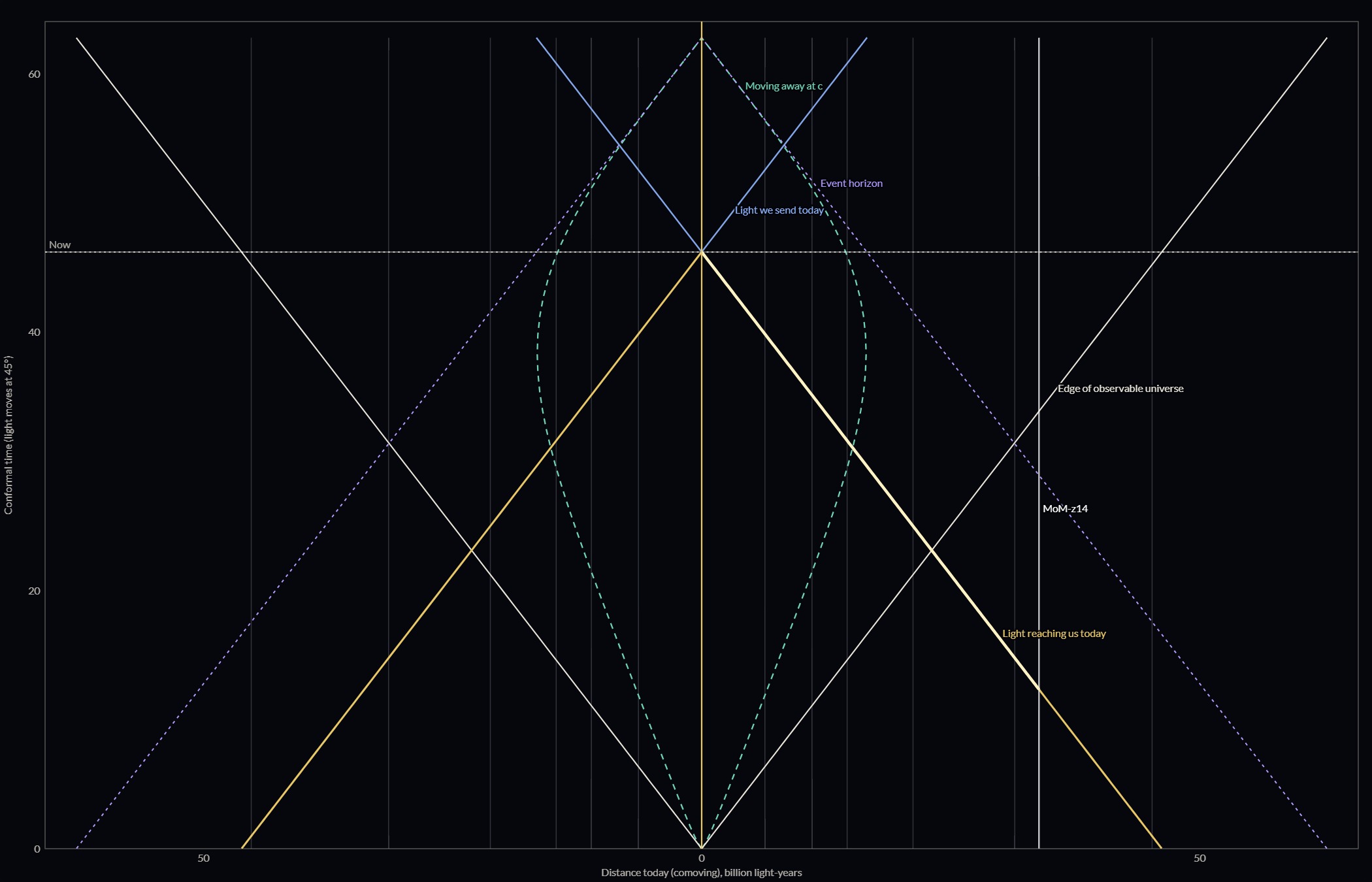 Today's distances, conformal time
Every galaxy sees the same
The "How far can we see?" view today, centred on us (left) and on another galaxy 15.7 billion light-years away (right). The circles are identical. Every galaxy is at the centre of its own observable universe, and none of them is at the centre of the universe. The Big Bang happened everywhere, not at a point.
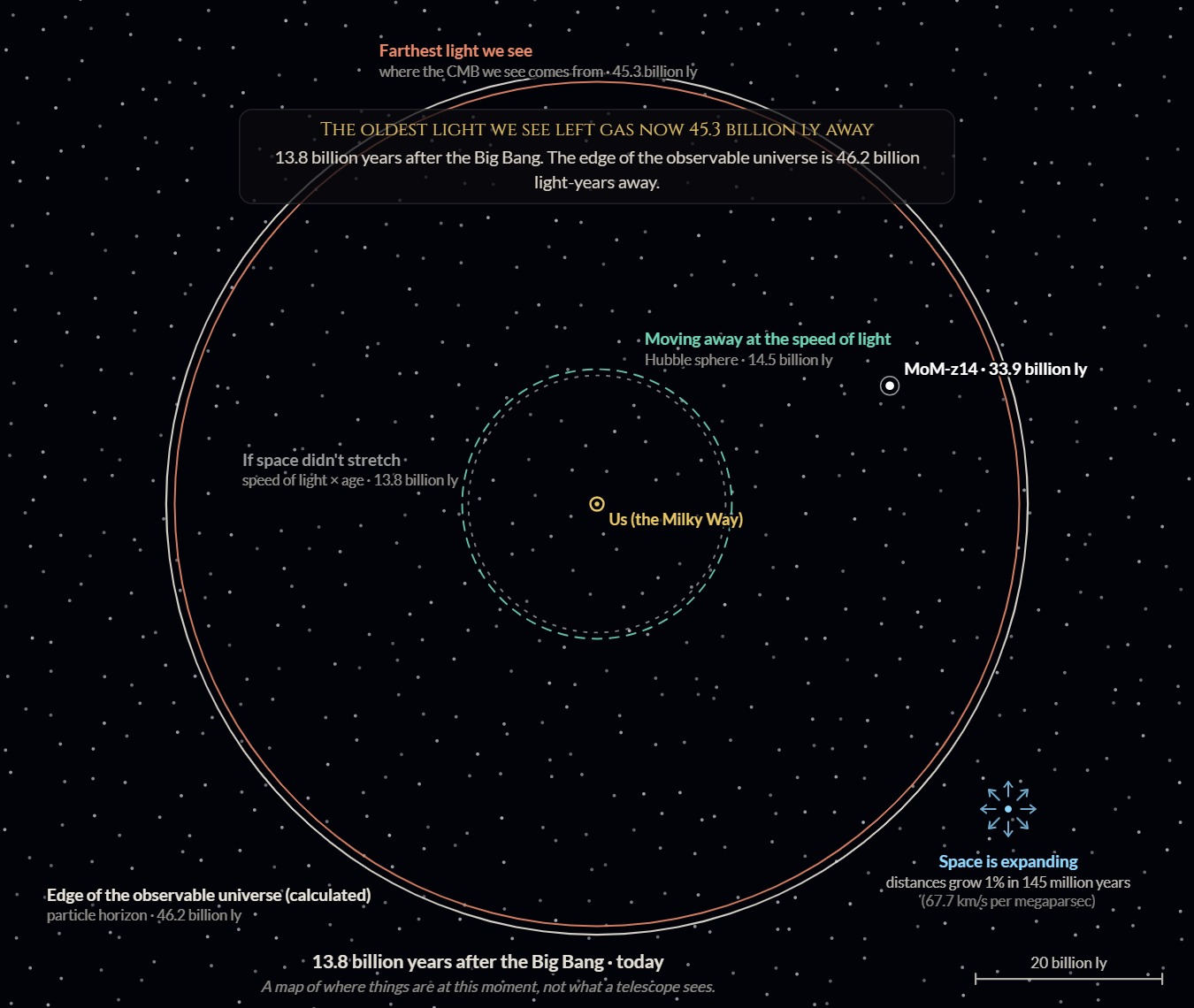 Centred on us
 Centred on another galaxy
Timescales
How Fast the Clock Runs
| View | Shows | Playback |
|---|---|---|
| Light from a distant galaxy | 13.5 billion years, from when the light left to today | 45 seconds: about 300 million years per second; then it holds still for 6 seconds when the light arrives, and zooms out if needed before starting again |
| How far can we see? | From the Big Bang to today | 40 seconds, slow at first and faster later, so the early universe can be seen |
| Faster than light? | Today (the time slider runs to 27.6 billion years) | Paused |
| Out of reach, and the far future | From today to a trillion years | 45 seconds, each second covering 1.10 times as much time as the one before |
Limits
What This Model Leaves Out
- A perfectly smooth universe. The calculation describes the average expansion. Real galaxies also have their own motions, of hundreds of kilometres per second, which dominate the redshifts of nearby galaxies, and things held together by gravity (stars, galaxies, groups and clusters of galaxies) don't expand.
- Dark energy as a constant. Planck's standard model, used here, has a cosmological constant. DESI's hint that dark energy is weakening is not settled. The past (the light we see, the edge of the observable universe) would change little, but the event horizon and the far future depend on how dark energy behaves from now on.
- Neutrinos. All three kinds are counted as radiation, while Planck's model gives one of them a small mass. Treating that exactly changes the distances by 0.03% and the age by 0.005%.
- The earliest moments. The model runs back to the Big Bang with radiation alone. If the universe went through a brief period of very rapid expansion first (inflation), the true particle horizon is far larger, but that doesn't change what we can see, which ends at the cosmic microwave background.
- One set of measurements. The numbers use Planck's 2018 values with galaxy-survey data (expansion rate 67.66 ± 0.42 km/s per megaparsec, matter 31.1 ± 0.6% of the total). Other analyses, and the Hubble tension, move them by a few percent.
- The map is a stand-in. It shows the universe at one moment of cosmic time, which no one can see, and its dots are a pattern, not real galaxies. In curved universes (Custom), distances along each line of sight are to scale but the map can't show the curvature.
- Recession speed is a convention. It is defined here, as in most of cosmology, with distances measured at one moment of cosmic time. With other definitions of distance and time the speeds differ; the redshift and everything that is observed does not. In an empty universe, for example, the same "faster than light" recession is ordinary special relativity in different coordinates.
I'm sure I've gotten some details wrong, so corrections are welcome.
Method
How It's Computed
- The expansion. For a smooth universe with scale factor a (1 today), the Friedmann equation gives the expansion rate
H(a)2 = H02 [Ωr a−4 + Ωm a−3 + Ωk a−2 + ΩΛ], Ωk = 1 − Ωr − Ωm − ΩΛ.Planck 2018 (TT,TE,EE+lowE+lensing+BAO): H0 = 67.66 km/s/Mpc, Ωm = 0.3111, flat. Radiation from the CMB temperature, 2.7255 K (Fixsen 2009), with three neutrino species: Ωr = Ωγ[1 + (7/8)(4/11)4/3 Neff], Neff = 3.046, so Ωr = 9.14 × 10⁻⁵. Units: billions of years and billions of light-years, so the speed of light is 1; 1/H0 = 14.45.
- Time and light. Cosmic time and the distance light can travel (in today's units, comoving) are
t(a) = ∫0a da′ / (a′ H), η(a) = ∫0a da′ / (a′2 H).η(a) is the comoving radius of the observable universe at a; light received at aobs from comoving distance χ left when η = η(aobs) − χ. The event horizon is χe(a) = ∫a∞ da′/(a′2H), finite only if the expansion accelerates forever. Distances at a moment (proper distances) are a times comoving ones; the Hubble sphere is at c/H; the recession speed of a comoving galaxy is v = H D, and light heading toward us changes its distance at dD/dt = H D − c, so it gets farther away while D > c/H.
- An object at redshift z. 1 + z = 1/ae; distance now χ = η(1) − η(ae); distance then χae; light-travel time t0 − t(ae); angular-size distance Sk(χ)/(1 + z), with Sk = sinh, identity or sin for open, flat or closed space. A signal we send today reaches it when η(a) = η(1) + χ.
- Numerics. t and η are tabulated in ln a from 10−12 to e72 (4,800 intervals, 8-point Gauss–Legendre) and interpolated by quintic Hermite polynomials with exact first and second derivatives. Before the table, the exact radiation-plus-matter solution; beyond it, the exact dark-energy limit. The event horizon at large a is integrated directly in 1/a. Inverses (a at a given time) use Newton's method on the table; special redshifts are roots found by bisection. Rebuilding a universe takes about 2 milliseconds, so the sliders are live.
- Allowed universes. Custom universes must start in a Big Bang (with matter or radiation), expand forever with a margin away from a bounce or a stall (a2H2/H02 ≥ 0.05), and, if closed, never let the observable universe reach 90% of the way around.
- The map and diagram. Circles and positions are the proper distances above at the chosen cosmic time; the dots are a nested random pattern in comoving coordinates (fixed, so zooming adds dots without moving any), scaled by a. Interpretation: the redshift relation and the recession speed are exact in these coordinates. Whether the redshift is best described as the stretching of space or as a Doppler shift built up along the light's path is a matter of interpretation (Bunn and Hogg 2009); the observable predictions are the same.
Verification
A separate Python program, written independently of the page, computes the same quantities with mpmath at 35 significant digits (and again at 45, to estimate its own error: below 10−27). The page's own code is run against it in a browser, for ten universes from ours to radiation-only, open, closed and Davis and Lineweaver's model.
| Test | Result |
|---|---|
| Age, edge of the observable universe, Hubble sphere, event horizon and its limit, special redshifts, light-cone maximum, angular-size peak (10 universes) | Within 2 × 10⁻¹³ |
| Distances, times and recession speeds at 19 redshifts (10 universes) | Within 10−11 |
| Cosmic time, scale factor and light-travel distance from a = 10−8 to 1012 and up to a trillion years | Within 4 × 10⁻¹² |
| When a signal sent today arrives; far-future redshifts | Within 3 × 10⁻¹⁰ (worst for a galaxy right at the event horizon) |
| Two methods: the light's distance from the tables vs step-by-step integration of dD/dt = HD − c (MoM-z14) | Within 10−9 |
| Exact formulas in the reference: matter only, radiation only, matter and dark energy (age); the event horizon's limit 1/(H0√ΩΛ) | Within 10−27; the limit is approached as expected (to 10−25 at a = 1012) |
| A second independent check of the reference: the astropy library (8.0.2), ages and distances in 7 universes | Within 9 × 10⁻¹⁰ |
| Planck's published age, 13.787 ± 0.020 billion years | 13.786 here; 13.787 with the massive neutrino treated exactly |
| Davis and Lineweaver's numbers for their model (Ωm = 0.3, ΩΛ = 0.7, H0 = 70, no radiation) | Recession equals c at z = 1.457 (quoted 1.46); event horizon now at z = 1.805 (1.8); CMB receding at 3.20c now and 58.1c then (3.2, 58.1); particle horizon 46.2 (46), event horizon 15.9 (16), Hubble sphere 14.0 billion light-years (14). Their "first ≈ 5 billion years" of light emitted while receding faster than light is 3.96 billion years when computed. |
| Universes the page refuses (no Big Bang, recollapse, seeing past the far side of a closed universe) and accepts | 7 of 7 correct |
Sources
References
- Friedmann, A. (1922). Über die Krümmung des Raumes. Zeitschrift für Physik, 10, 377. ADS
- Lemaître, G. (1927). Un univers homogène de masse constante et de rayon croissant. Annales de la Société Scientifique de Bruxelles, A47, 49. English translation (abridged): MNRAS, 91, 483 (1931). DOI
- Hubble, E. (1929). A relation between distance and radial velocity among extra-galactic nebulae. PNAS, 15, 168. DOI
- Tolman, R. C. (1930). On the estimation of distances in a curved universe with a non-static line element. PNAS, 16, 511. DOI
- Rindler, W. (1956). Visual horizons in world models. MNRAS, 116, 662. DOI
- Harrison, E. R. (1991). Hubble spheres and particle horizons. The Astrophysical Journal, 383, 60. DOI
- Davis, T. M., & Lineweaver, C. H. (2004). Expanding confusion: common misconceptions of cosmological horizons and the superluminal expansion of the universe. Publications of the Astronomical Society of Australia, 21, 97. DOI
- Lineweaver, C. H., & Davis, T. M. (2005). Misconceptions about the Big Bang. Scientific American, 292(3), 36.
- Bunn, E. F., & Hogg, D. W. (2009). The kinematic origin of the cosmological redshift. American Journal of Physics, 77, 688. DOI
- Hogg, D. W. (1999). Distance measures in cosmology. arXiv:astro-ph/9905116
- Planck Collaboration (2020). Planck 2018 results. VI. Cosmological parameters. Astronomy & Astrophysics, 641, A6 (Table 2). DOI
- Fixsen, D. J. (2009). The temperature of the cosmic microwave background. The Astrophysical Journal, 707, 916. DOI
- Perlmutter, S., et al. (1998). Discovery of a supernova explosion at half the age of the Universe. Nature, 391, 51. DOI
- Riess, A. G., et al. (1998). Observational evidence from supernovae for an accelerating universe and a cosmological constant. The Astronomical Journal, 116, 1009. DOI
- Perlmutter, S., et al. (1999). Measurements of Ω and Λ from 42 high-redshift supernovae. The Astrophysical Journal, 517, 565. DOI
- Goldhaber, G., et al. (2001). Timescale stretch parameterization of type Ia supernova B-band light curves. The Astrophysical Journal, 558, 359. DOI
- Blondin, S., et al. (2008). Time dilation in type Ia supernova spectra at high redshift. The Astrophysical Journal, 682, 724. DOI
- Lubin, L. M., & Sandage, A. (2001). The Tolman surface brightness test for the reality of the expansion. IV. A measurement of the Tolman signal and the luminosity evolution of early-type galaxies. The Astronomical Journal, 122, 1084. DOI
- Riess, A. G., et al. (2022). A comprehensive measurement of the local value of the Hubble constant with 1 km/s/Mpc uncertainty from the Hubble Space Telescope and the SH0ES team. The Astrophysical Journal Letters, 934, L7. DOI
- DESI Collaboration (2025). DESI DR2 results II: measurements of baryon acoustic oscillations and cosmological constraints. Physical Review D, 112, 083515. DOI. Popovic, B., et al. (2026). The Dark Energy Survey supernova program: a reanalysis of cosmology results and evidence for evolving dark energy with an updated type Ia supernova calibration. MNRAS. DOI
- Krauss, L. M., & Scherrer, R. J. (2007). The return of a static universe and the end of cosmology. General Relativity and Gravitation, 39, 1545. DOI
- Valcin, D., et al. (2020). Inferring the age of the universe with globular clusters. Journal of Cosmology and Astroparticle Physics, 12, 002. DOI
- Naidu, R. P., et al. (2026). A cosmic miracle: a remarkably luminous galaxy at zspec = 14.44 confirmed with JWST. The Open Journal of Astrophysics, 9. DOI
- Carniani, S., et al. (2025). The eventful life of a luminous galaxy at z = 14. Astronomy & Astrophysics, 696, A87. DOI. Schouws, S., et al. (2025). Detection of [O III] 88 µm in JADES-GS-z14-0 at z = 14.1793. The Astrophysical Journal, 988, 19. DOI
- Bunker, A. J., et al. (2023). JADES NIRSpec spectroscopy of GN-z11. Astronomy & Astrophysics, 677, A88. DOI
- Euclid Collaboration: Yang, D., et al. (2026). Euclid: discovery of 31 new quasars at 6.6 < z < 7.8. Astronomy & Astrophysics, 711, A104. DOI; ESA news release, 6 July 2026. Link
- Welch, B., et al. (2022). A highly magnified star at redshift 6.2. Nature, 603, 815. DOI. Pascale, M., et al. (2025). Is Earendel a star cluster? arXiv:2507.05483 (redshift of the host arc, 5.926). NASA (2022), Record broken: Hubble spots farthest star ever seen. Link
- Schmidt, M. (1963). 3C 273: a star-like object with large red-shift. Nature, 197, 1040. DOI
- Mei, S., et al. (2007). The ACS Virgo Cluster Survey. XIII. SBF distance catalog and the three-dimensional structure of the Virgo cluster. The Astrophysical Journal, 655, 144. ADS
- NASA/IPAC Extragalactic Database (NED): redshifts of the Coma Cluster, 3C 273 and Andromeda (accessed 17 October 2026). Link. van der Marel, R. P., et al. (2012). The M31 velocity vector. II. The Astrophysical Journal, 753, 8. DOI
Notes on the numbers (all computed by the page's own code for the Planck 2018 model unless stated): a gap of one light-year grows at H0 × 1 light-year = 2.07 cm/s, 74.7 m per hour. The gas that sent the CMB is now 45.27 billion light-years away; dividing by 1 + z = 1090.8 gives 41.5 million light-years when the light left. Hubble's 500 km/s/Mpc gives 1/H0 = 1.96 billion years. Light that a galaxy at redshift 1 sends today arrives when the universe is 32.7 billion years old. The comoving radius of everything we will ever see is η(∞) = 62.77 billion light-years, and (62.77/46.19)3 = 2.5. Reachable today: (16.58/46.19)3 = 4.6% of the observable universe; (16.58/χ(z = 20))3 = 10.0% of the volume out to redshift 20, about where the first galaxies formed. The coincidence: the speed of light times the age over the Hubble radius is 13.79/14.45 = 0.954. When the universe is 150 billion years old, the scale factor is 2,664 and the Virgo Cluster's light arrives with z = 8.2, Coma's with 53. The Hubble sphere and the speed of light × age are equal at 14.95 billion years, 1.17 billion years from now. MoM-z14's light got farther from us from 0.283 to 4.05 billion years after the Big Bang (3.77 billion years); 340 million years after the Big Bang it was 2.42 billion light-years away. Andromeda's 300 km/s is relative to the Sun (NED); relative to the Milky Way it is 109 km/s (van der Marel et al. 2012).
Use These Images
Free to Use, With Credit
Images you make with this simulator, and the figures on this page, may be used for any purpose, including teaching, publication and commercial work, without asking permission. We only ask that you credit Frosty Wren Studios, for example:
Cosmic horizons simulation: Frosty Wren Studios, frostywren.com/cosmic-horizons"Save image" adds this line to the corner of each picture by default; you can switch it off under Playback and output. The simulator's source code is not covered by this permission. The page uses only published measurements (the Planck parameters and published redshifts) and its own calculations; no images or data files from other sources.