The universe is 13.8 billion years old, and nothing travels faster than light. So the most distant thing we can see should be 13.8 billion light-years away. It isn't: the oldest light we see left gas that is now about 45 billion light-years away. This simulator shows why, calculated live in your browser from the measured contents of the universe. It follows our black hole, pulsar, microlensing and light-speed simulations, and like them it is calculated, not drawn.
What you’re looking at
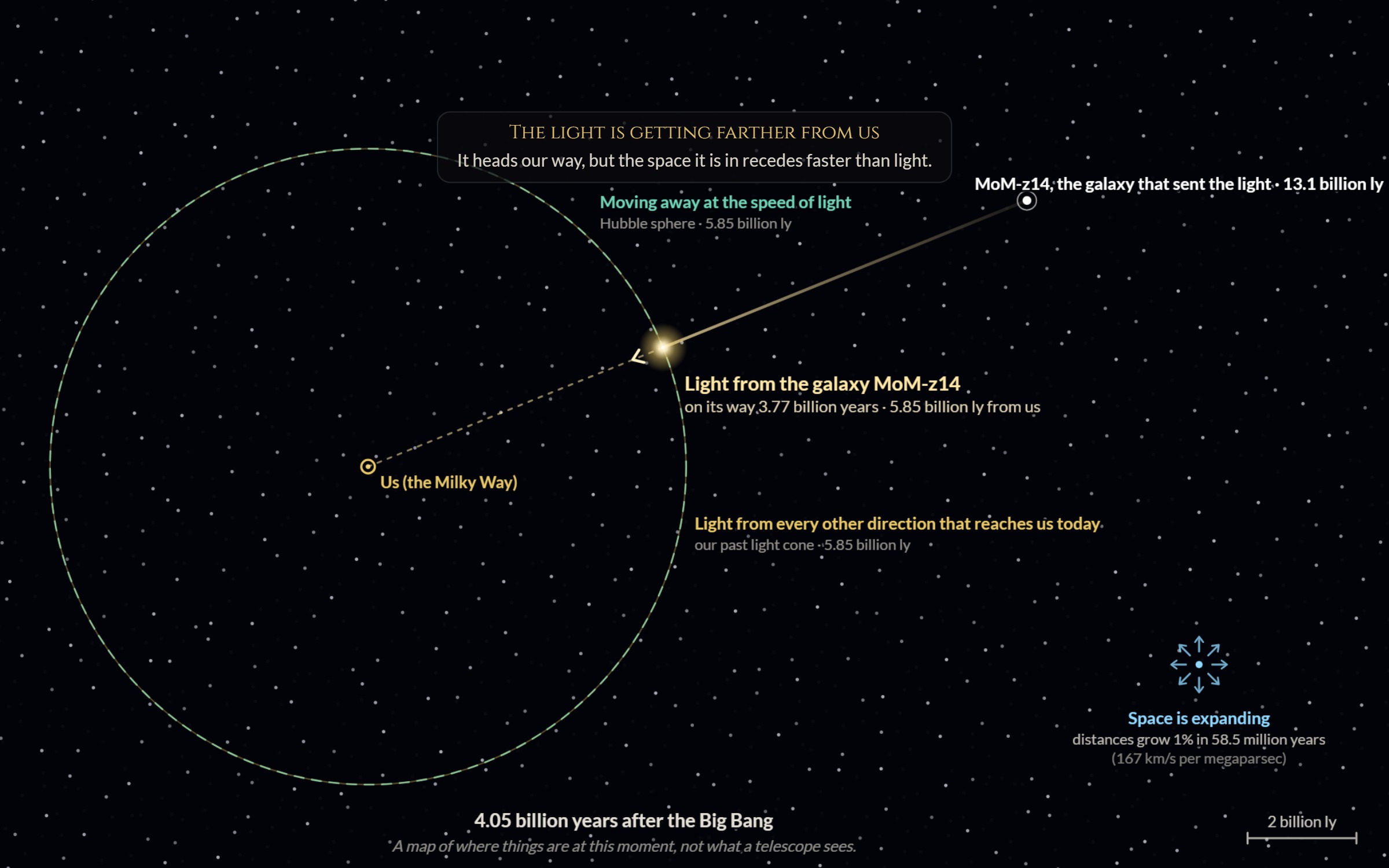
- A map, not a photograph. It shows where things are at one moment of cosmic time, with us at the centre. A telescope can't see this: looking out is looking back in time, so it shows each galaxy where it was when its light left.
- The dots stand in for galaxies. As the universe expands, the distances between them all grow in proportion, and the farther apart two galaxies are, the faster the distance between them grows. Seen from any of them, the picture is the same. There is no centre.
- The bright dot is the light of the chosen galaxy on its way to us, and the faint gold circle shows where, at that moment, all the light that reaches us today is, from every direction.
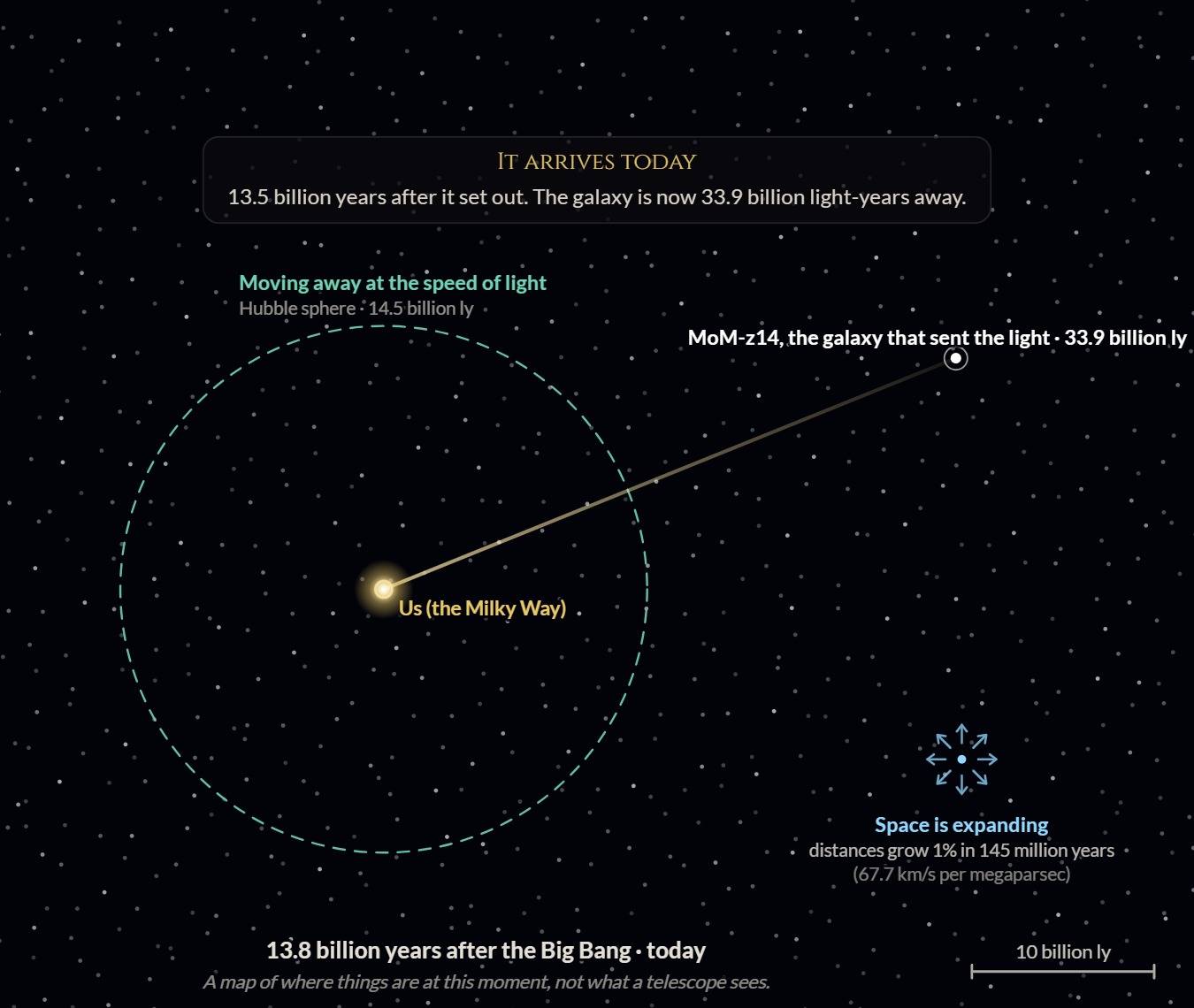
- The dashed teal circle is where things recede at the speed of light (the Hubble sphere), 14.5 billion light-years away today.
- The red and white circles are the farthest light we see (the cosmic microwave background) and the edge of the observable universe.
The surprise: faster than light, and still in view
There are several common misconceptions about the expanding universe. Here are three, and what the calculation shows instead.
First: galaxies can move apart faster than light. Every galaxy we see with a redshift above about 1.5 is receding from us faster than light: its distance from us grows by more than a light-year per year. That doesn't break relativity. Relativity says that nothing can move through space faster than light, so nothing can overtake a beam of light. No galaxy does that: each one moves only slowly through the space around it, and anyone in any galaxy who measures a passing beam of light finds it moving at exactly the speed of light. What grows faster than light is the amount of space between us and a distant galaxy, and relativity sets no limit on how fast that can grow.
Second: we can still see those galaxies, and their light at first moved away from us. Light from such a galaxy crosses the space around it toward us at the speed of light, but that space is itself receding from us faster than light. So at first the light is carried away from us, even though it is heading our way. The distance at which space recedes at exactly the speed of light grows over time, and once it has grown past the light, the light starts to come closer. MoM-z14's light set out where space receded at 5.2 times the speed of light, and spent its first 3.8 billion years getting farther away. In fact, all the light reaching us today was never more than 5.85 billion light-years from us, so every galaxy we see, however far it is now, was closer than that when its light set out.
Third: we can't reach everything we see. The expansion has been speeding up for the last 6 billion years. Because of that, light we send out today will never reach galaxies we now see with a redshift above 1.85, more than 16.6 billion light-years away, and whatever happens there today we will never see. Of the observable universe out to the first galaxies, that is about 90% by volume (the universe as a whole may be far larger, even infinite). We won't stop seeing them, though: their old light keeps arriving, ever redder and dimmer, as if they were frozen in time.
Three answers to “how far away?”
For the farthest galaxies, news stories usually say how long their light travelled: MoM-z14's light travelled for 13.5 billion years. The galaxy was 2.2 billion light-years away when that light left, and is 33.9 billion light-years away now. All three are correct; they answer different questions. The simulator shows all three for every object, from the Virgo Cluster to the cosmic microwave background.
How astronomers measure it
A galaxy's redshift is read from its spectrum: lines of hydrogen or oxygen arrive stretched by the same factor by which distances have grown since the light left. Distances come from stars and supernovae of known brightness, and from a pattern of known size in how galaxies are spread out, left by sound waves in the early universe. The cosmic microwave background, mapped by the Planck satellite, tells us what the universe contains: about 5% ordinary matter, 26% dark matter and 69% dark energy. Those numbers are the input to the simulator. Everything else, every distance, horizon and time on the page, follows from one equation, Alexander Friedmann's from 1922.
Animation vs. simulation
An animation is drawn to look right. Here nothing is drawn: every circle and position comes from Friedmann's equation for the expansion and from how far light can travel while distances grow. Change what the universe is made of, and everything changes with it. Take away dark energy and the universe would be only 9.6 billion years old, younger than its oldest stars, and with no event horizon: every galaxy could eventually be reached.
Comparing against known results
A separate program, written independently with 35-digit arithmetic, works out the same quantities. The simulator agrees with it to better than one part in a billion, for our universe and nine others. It reproduces the age measured by the Planck satellite (13.787 billion years; 13.786 here) and the numbers that Tamara Davis and Charles Lineweaver published in 2004 in their paper on these misconceptions, which this page follows.
Where to view it
It runs on any computer or phone. It opens on the light of one of the farthest galaxies ever observed. Then try “How far can we see?”, “Faster than light?” and the far future, and open the spacetime diagram.
Built with Claude Opus 5.5
I built this with Claude Opus 5.5: the physics design, the drawing code, the test programs that check it, and the write-up. Every image comes from the simulator itself, and the method section gives the equations, the tests and the sources.
I’m sure I’ve gotten some details wrong, so corrections are welcome. The images are free to use, for teaching or anything else, with credit. Try it here.