Imagine you're on a spaceship, looking out of the front window, as it speeds up to 99% of the speed of light. What happens to the stars? Most of us picture the jump to hyperspace in Star Wars: the stars stretch into streaks and rush outward past the ship. This simulator calculates the answer with the real night sky, following our fly-by, black hole and pulsar pages, and the answer is nearly the opposite. The stars slide inward, toward the point you're heading for. They crowd into a small circle and turn blue-white, the sky behind you goes dark, and the space between the stars ahead starts to glow.
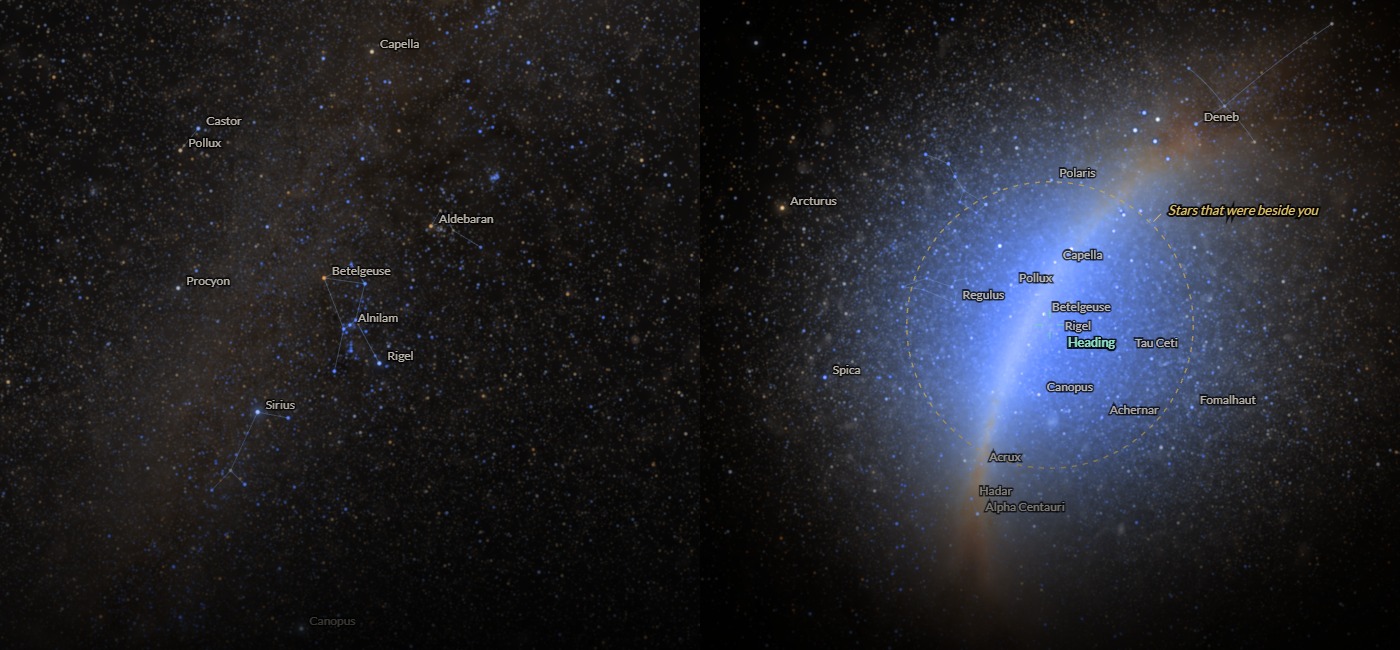
What you're looking at
- The real sky. 270,000 stars from the Henry Draper Catalogue, made at Harvard a century ago, each in its catalogued place with its brightness and the colour of its spectral type, plus the glow of the Milky Way, measured in the near infrared by the COBE satellite, and the dust between the stars. The ship starts beside the Sun, heading for Orion's Belt.
- Two views side by side. On the left, the sky as it looks standing still. On the right, the same sky as the ship speeds up to 99% of the speed of light and slows down again. A short label says what to notice.
- A dashed circle marks where the stars that were beside the ship have gone. Everything that was in front of you is inside it: 26° from the direction of travel at 90% of light speed, 8° at 99%.
- Other views show the whole sky on one disc, the view looking back, the movie version beside the real one, the glow at extreme speeds, a trip to Alpha Centauri, and how astronomers measure our own motion through the universe.
Why the stars move inward
The stars aren't moving. Their light reaches the moving ship at a slant. You've seen the same thing in rain: when rain falls straight down and you run through it, it seems to come at you from the front, and the faster you run, the more it does. Light does the same, and near the speed of light the effect is huge: at 99% of light speed, half of the whole sky, everything that was in front of you, is squeezed into a circle 16° across.
It doesn't distort the shapes of things. Orion shrinks as it crowds toward the direction of travel, but it keeps its shape. The simulator has a switch that zooms back in by just the right amount, and Orion reappears at its normal size, only bluer.
Colours, and stars that brighten
Light from ahead arrives with its frequency raised, so it looks bluer, and light from behind arrives redder: the Doppler effect, the same thing that makes an ambulance siren drop in pitch as it passes. That doesn't simply make the stars ahead brighter. Cool red stars give off most of their light as infrared, which is now shifted into view, so they brighten a lot; hot blue stars push their light into the ultraviolet and fade. At 90% of light speed, red Betelgeuse outshines the blue stars of Orion's Belt more than a hundred times over. And looking back, the stars slide away, turn red and fade until, by 90% of light speed, the sky behind is almost empty.
The surprise: the sky ahead glows
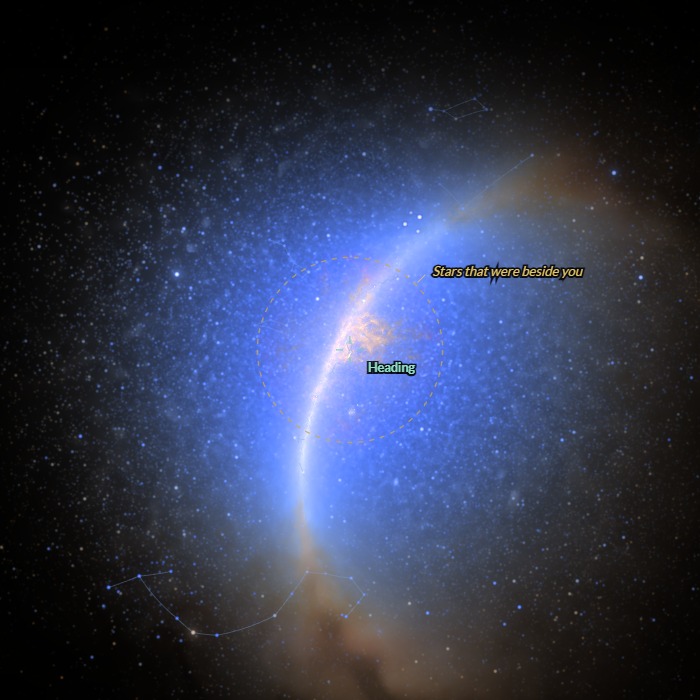
While working on this, I was surprised to find that the most striking thing at high speed isn't the stars at all. Space between the stars isn't really dark. It is full of light our eyes can't see: infrared from the billions of faint stars of the Milky Way, from the dust between them, and from all the galaxies in the universe, and the afterglow of the Big Bang, which is microwaves. Near light speed all of that light ahead is shifted toward the visible and crowded into a smaller patch of sky.
So, heading toward Orion, the glow straight ahead is brighter than a moonlit sky at 90% of light speed, like the sky soon after sunset at 99.9%, and brighter than a clear daytime sky at 99.99%. Most of that light is the infrared glow of the dust clouds around Orion, and those figures are, if anything, too low. At the most extreme speeds the afterglow of the Big Bang takes over: at 99.99996% of light speed it is as hot, straight ahead, as the surface of the Sun.
No starbow
In 1962 the rocket engineer Eugen Sänger predicted that a fast ship's crew would see a rainbow wrapped around the sky, violet at the front and red at the back. The science-fiction writer Frederik Pohl named it the "starbow" in a 1972 story, and it became a staple of science fiction. But Sänger had treated every star as shining in a single colour. Real stars shine across the whole spectrum, and shifting that kind of light only moves a star's colour between orange, white and pale blue. In 1979 two physicists, McKinley and Doherty, did the calculation with real stars and found that no starbow appears. The simulator agrees.
We already measure it
Nothing we've built goes anywhere near fast enough to see the sky crowd ahead; Voyager 1, at 17 km/s, sees stars shift by about the width of a coin at 400 metres. But astronomers measure the same effects all the time. James Bradley discovered the slant of starlight in 1725–28, caused by the Earth's 30 km/s around the Sun. And the Big Bang's afterglow is 0.0034 degrees warmer in the direction the Sun is moving, at 370 km/s, toward the constellations Leo and Crater, which is how we know that speed. The COBE, WMAP and Planck satellites have all mapped it.
A trip to the nearest star
One view flies a ship to Alpha Centauri, 4.4 light-years away, at a steady 1 g: accelerating as hard as gravity pulls on Earth for half the way, then slowing down. It reaches 95% of light speed. On board, the trip takes 3.6 years; on Earth, 6 years pass. At the end the ship turns round, and the Sun is just a bright star, sitting at the end of the W of Cassiopeia.
Animation vs. simulation
Nothing in the program says "move the stars inward" or "make the sky glow". For every star, every frame, your graphics card works out where its light appears to come from, how its colour shifts and how bright it looks, from the equations of special relativity; for every pixel, it does the same for the glow, using measured maps of the sky. A separate program, written independently, checks the physics, and further tests read back what the graphics card draws and check that it adds up to the light the physics predicts. Each effect can be switched off, so you can see what it does. The method page has the equations, the data and all the tests, and the simulator page lists what the model leaves out.
Where to view it
It runs on your device's graphics card and works best on a laptop or desktop. It opens on "Speed up". Then try "Movies vs reality", "Whole sky" to see the whole sky gather toward the front, "Look back", "The glow ahead" for the most extreme speeds, or "Journey to Alpha Centauri".
Built with Claude Opus 5.5
I built this with Claude Opus 5.5: the physics design, the data preparation, the GPU code, the test programs that check it, and the write-up. Every image comes from the simulator itself.
I'm sure I've gotten some details wrong, so corrections are welcome. The images are free to use, for teaching or anything else, with credit. Try it here.