At the center of the Milky Way, 27,000 light-years away, there is an object 4.3 million times the mass of the Sun, packed into a space smaller than our solar system. Nobody can see it directly in ordinary light. We know it is there, and how heavy it is, from the stars that orbit it, and above all from one star, called S2 (S0-2 to the Keck team), which goes around it once every 16 years. This simulator calculates S2's orbit live in your browser from Einstein's general relativity and shows it the way the telescopes see it. It follows our black hole, pulsar, microlensing, light-speed and cosmic horizons simulations, and like them it is calculated, not drawn.
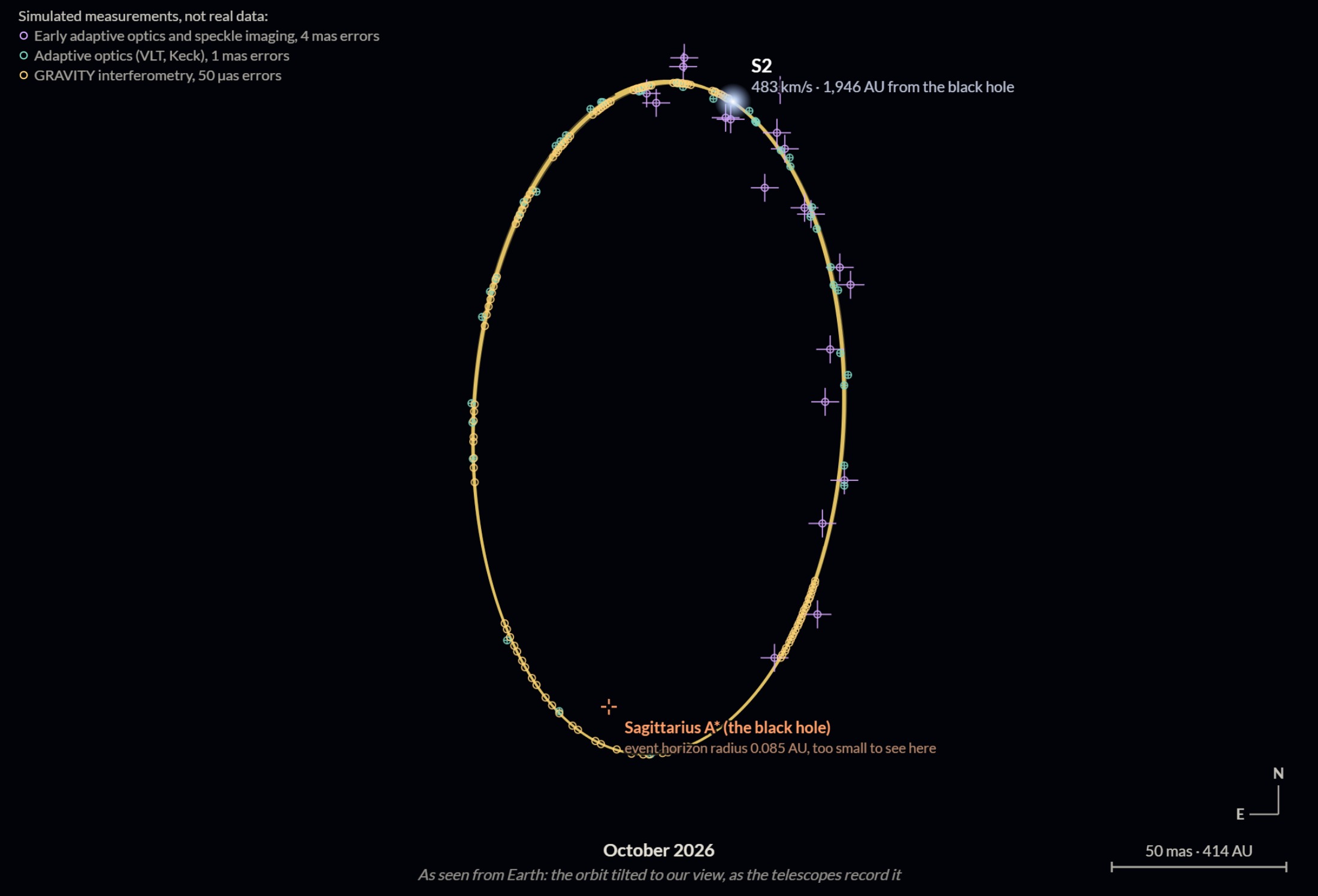
What you’re looking at
- The cross marks the black hole, Sagittarius A* (Sgr A* for short). Its event horizon, the boundary from inside which nothing escapes, is 25 million kilometers across. That would fit inside Mercury's orbit, but at this distance it is far too small to see.
- The ellipse is S2's orbit as seen from Earth, tilted to our view. It spans about a fifth of an arcsecond, the size of a coin seen from 25 kilometers away.
- The bright dot is the star. It is a hot young star of about 14 solar masses, and the telescopes see it as a single point of light.
- The hollow points show where measurements would fall if the calculation is right, with errors typical of the instruments of each era. They are simulated, not the real measurements, which can't be reused freely; the page explains how the real ones compare.
- The graph below shows the star's speed toward or away from us, which astronomers measure from the shift of the lines in its spectrum.
The surprise: it doesn't fall in
There are several common misconceptions about black holes. The first is that a black hole pulls in everything near it. At any given distance, a black hole pulls exactly as hard as a star of the same mass would. The difference is that you can get much closer to it, and only within a few times the size of its horizon does gravity behave in ways no ordinary orbit survives. A star in orbit around it stays in orbit, as the planets do around the Sun. At its closest, S2 passes Sgr A* at 119 times the Earth–Sun distance, about four times Neptune's distance from the Sun and 1,400 times the radius of the event horizon. It is moving at 7,750 kilometers per second there, fast enough to cross from London to New York in under a second, and then it swings back out to 1,950 times the Earth–Sun distance. It passed that farthest point in May 2026, and it will be back in June 2034.
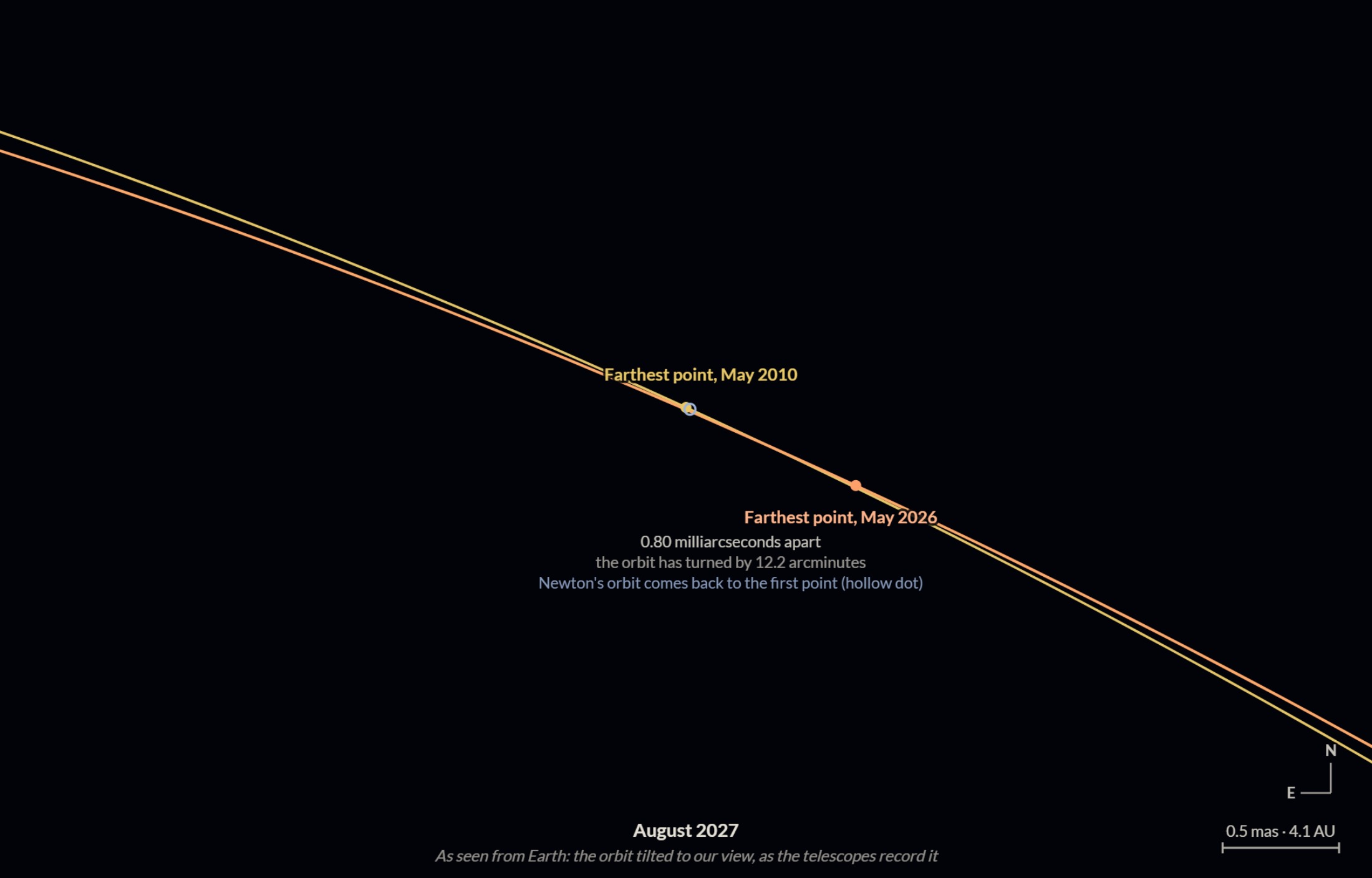
The second is that an orbit simply repeats. In Newton's gravity it would: the star would come back to the same closest point every 16 years. In general relativity, gravity pulls a little harder close in than Newton's inverse-square law says, so the star swings a little farther around before it heads out again, and each orbit is turned by 12 arcminutes from the one before. This is the Schwarzschild precession. Mercury's orbit turns the same way, by 43 arcseconds a century, but S2's turns about 7,000 times as much on every orbit, because it comes so much closer to the black hole compared with the size of the black hole's horizon. The GRAVITY team detected this turning in 2020, from S2's positions before and after its 2018 closest approach, and confirmed it with more stars in 2022 and 2024. At the far end of the orbit, where it shows most as seen from Earth, it moved S2's farthest point by 0.8 thousandths of an arcsecond between 2010 and 2026.
The third is that a star's light tells us only how it moves. At closest approach, S2's light arrives 207 kilometers per second redder than its motion explains. Half of that is gravitational redshift: light leaving the strong gravity near the black hole reaches us with less energy, so at a longer wavelength. The other half is time dilation: the star moves so fast that its clock runs slow, and so does the light it gives off. A clock on S2 then loses about a minute a day compared with a clock far away. Both the GRAVITY team and the Keck team measured this redshift in 2018.
How astronomers measure it
The center of our galaxy is hidden behind dust that blocks almost all of its visible light, so it is observed in the infrared. Since the 1990s two teams have followed the stars there: Reinhard Genzel's group with ESO's telescopes in Chile, and Andrea Ghez's group with the Keck telescopes in Hawaii. They used adaptive optics, a mirror that changes its shape hundreds of times a second to undo the blurring of Earth's atmosphere, to measure each star's position a few times a year, and spectra to measure its speed toward or away from us. Genzel and Ghez shared half of the 2020 Nobel Prize in Physics for showing that the center of the galaxy holds a supermassive compact object.
One star gives both the black hole's mass and its distance. The positions show the orbit's size in arcseconds and how long it takes; the speeds, in kilometers per second, give its size in kilometers. Put together through Kepler's laws, they give a mass of 4.3 million Suns and a distance of 27,000 light-years. Since 2016 the GRAVITY instrument has combined the light of four large telescopes to measure S2's position to about 50 millionths of an arcsecond, the size of a ball 9 centimeters across on the Moon, sharp enough to see the orbit turn. In 2022 the Event Horizon Telescope imaged the glowing gas around Sgr A*, and the size of the black hole's shadow agrees with the mass from the stars.
Animation vs. simulation
An animation is drawn to look right. Here nothing is drawn: the star's path comes from the equations of general relativity, starting from its orbit as published by the GRAVITY team, and the positions and speeds a telescope would record are computed from that path, including the time its light takes to cross the orbit. Switch relativity off and the orbit closes on itself; switch off the redshift and the speed curve moves by 207 km/s at closest approach. You can also put a star closer to the black hole than any we know, and watch its orbit turn by degrees every time around.
Comparing against known results
A separate program, written independently, calculates the same orbits with two different high-precision methods. For the real stars, the simulator agrees with it to a few billionths of a milliarcsecond on the positions and about a millionth of a kilometer per second on the speeds. It reproduces S2's closest approach in May 2018, its top speed and the redshift that the GRAVITY and Keck teams measured, and an exact calculation of the orbit in general relativity confirms the turning of 12.2 arcminutes per orbit.
Where to view it
It runs on any computer or phone. It opens on S2's orbit from 1992 to today. Then try “Closest approach, 2018”, “The orbit turns”, and “Measure it yourself”, where you find the mass and distance of a hidden black hole from simulated measurements.
Built with Claude Opus 5.5
I built this with Claude Opus 5.5: the physics design, the drawing code, the test programs that check it, and the write-up. Every image comes from the simulator itself, and the method section gives the equations, the tests and the sources.
I’m sure I’ve gotten some details wrong, so corrections are welcome. The images are free to use, for teaching or anything else, with credit. Try it here.